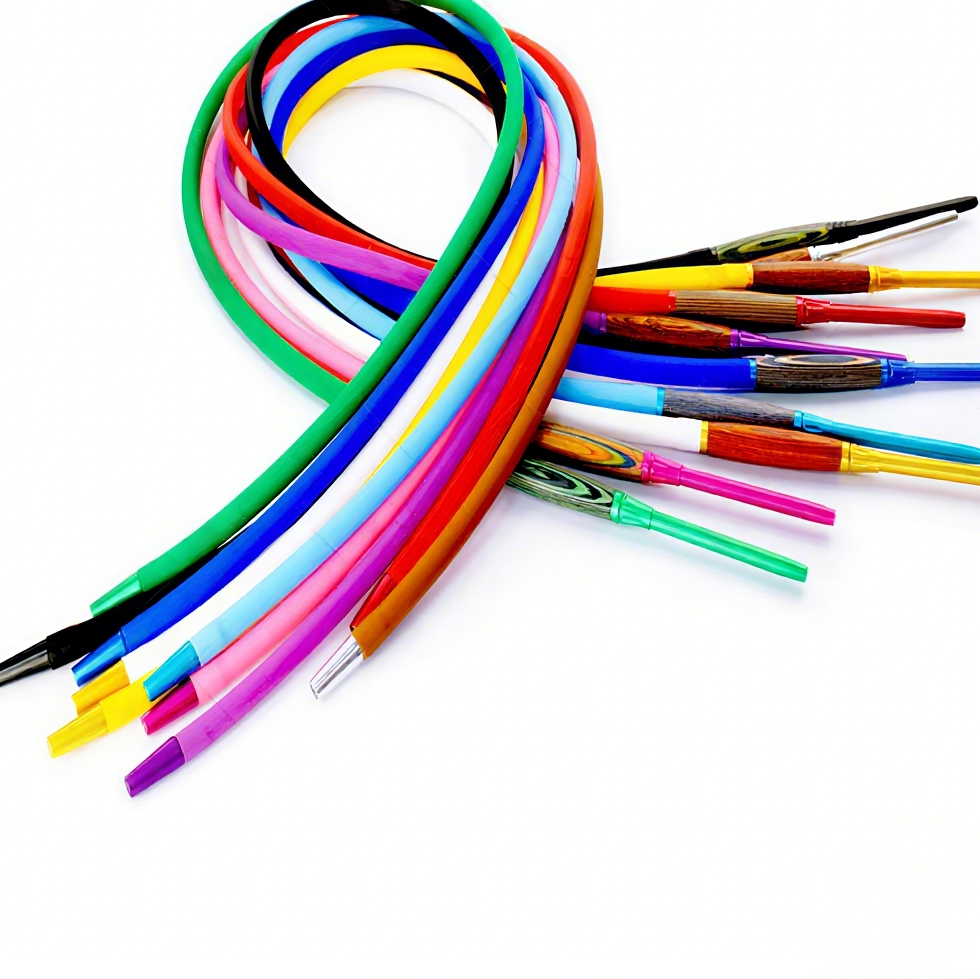
Which hookah pipe is best?
The best hookah pipe choice in B2B isn’t a flashy brand or the thickest hose. It’s the right silicone hose for your target market. If a hookah pipe hose controls odor, meets applicable food-contact requirements, fits your connectors, bends without kinking, and arrives consistent batch after batch, it’s the “best” for your project.
For B2B buyers, the best hookah pipe is the one with a food-grade silicone hose that meets your market’s compliance requirements, controls odor, maintains stable dimensions and hardness, fits your interfaces cleanly, cleans easily, and can be repeated reliably in mass production. Rank products by procurement risk reduction, not just price or wall thickness.
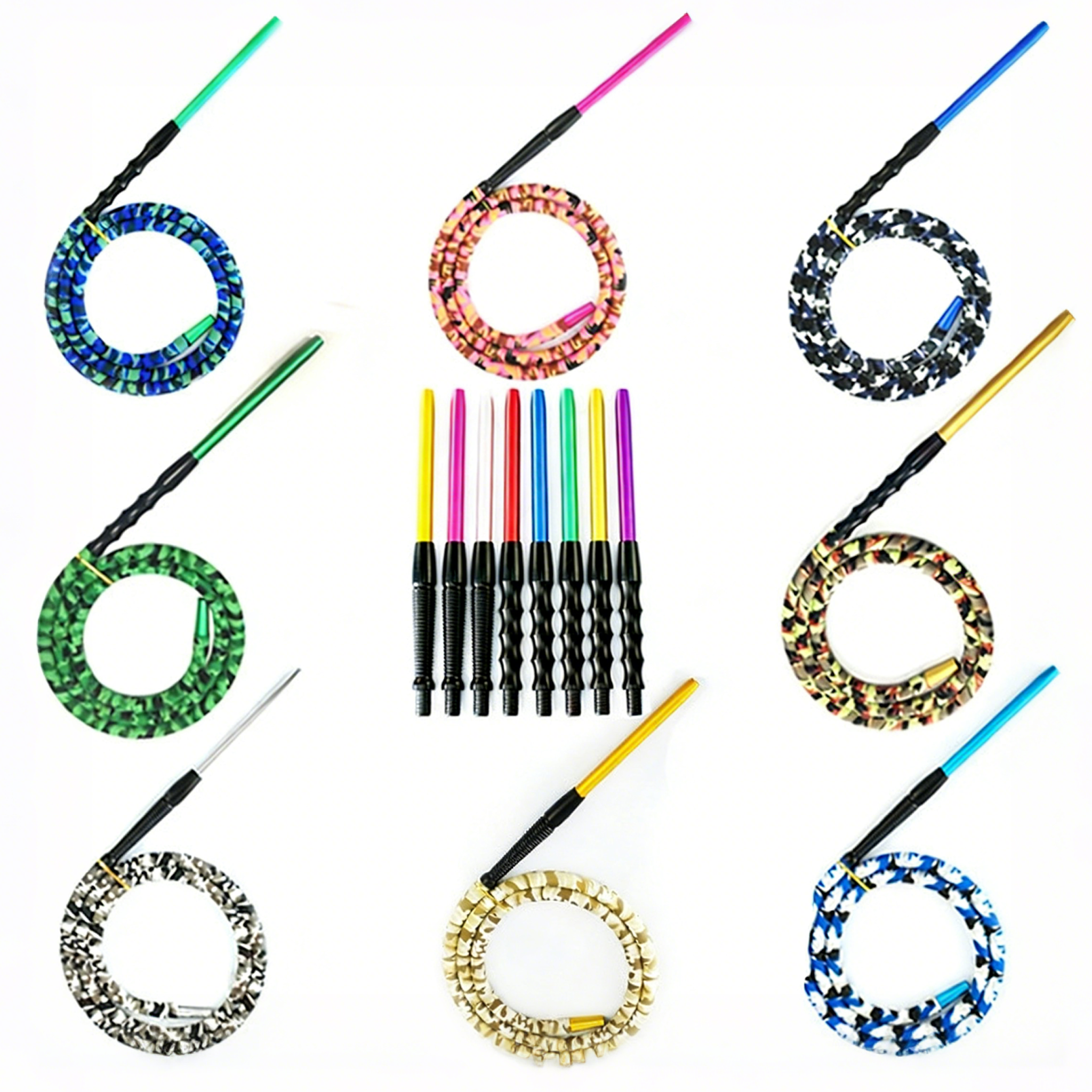
Choosing among “best” options is less about a consumer ranking and more about controlling procurement risks: odor complaints, unclear compliance, poor fit, and inconsistent re-orders. Below I share what I check with hookah brands and importers before sampling and before mass production, based on our silicone hose manufacturing experience.
What does “best hookah pipe” mean for B2B buyers?
Most buyers start with visuals and price, then discover returns or delays due to smell, fit, or documents. That hurts a launch. The “best” hookah pipe should reduce complaint risk and keep your rollout predictable. I focus conversations on how the hose performs in odor, compliance, interface fit, and repeatability.
The best hookah pipe for B2B is the one that reduces your total risk: low odor out of the box, proper food-contact documentation for your markets, clean fit to your mouthpiece and handle, correct hardness and flexibility for user feel, and stable, repeatable batches you can reorder without surprises.
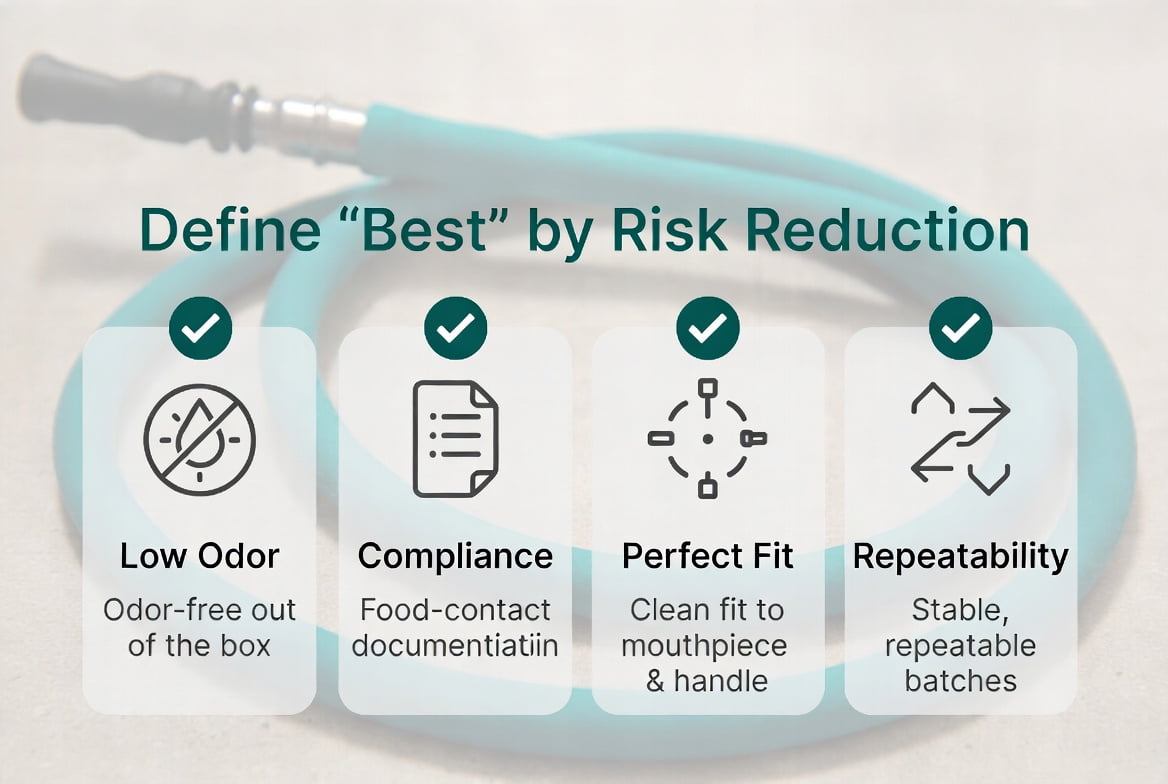
Reframe “best” as risk management
- Odor control: Early returns often start here. The hose must not carry a persistent curing odor.
- Compliance clarity: “Food-grade” claims alone aren’t enough; importers need the right declarations and test scope.
- Assembly fit: ID/OD tolerances must match your connectors and mouthpieces.
- User feel: Flexibility and bend radius drive the perceived quality.
- Consistency: Color, hardness, and dimensions must stay stable across batches.
I’ve supported several hookah brands through sampling where we adjusted hardness by 5 Shore A and tightened OD tolerance by ±0.2 mm to eliminate loose-fit issues on a new handle design. Those small changes turned a “nice sample” into a repeatable SKU that a warehouse team could receive and ship without sorting.
Does “food‑grade” automatically make a hookah pipe hose the best?
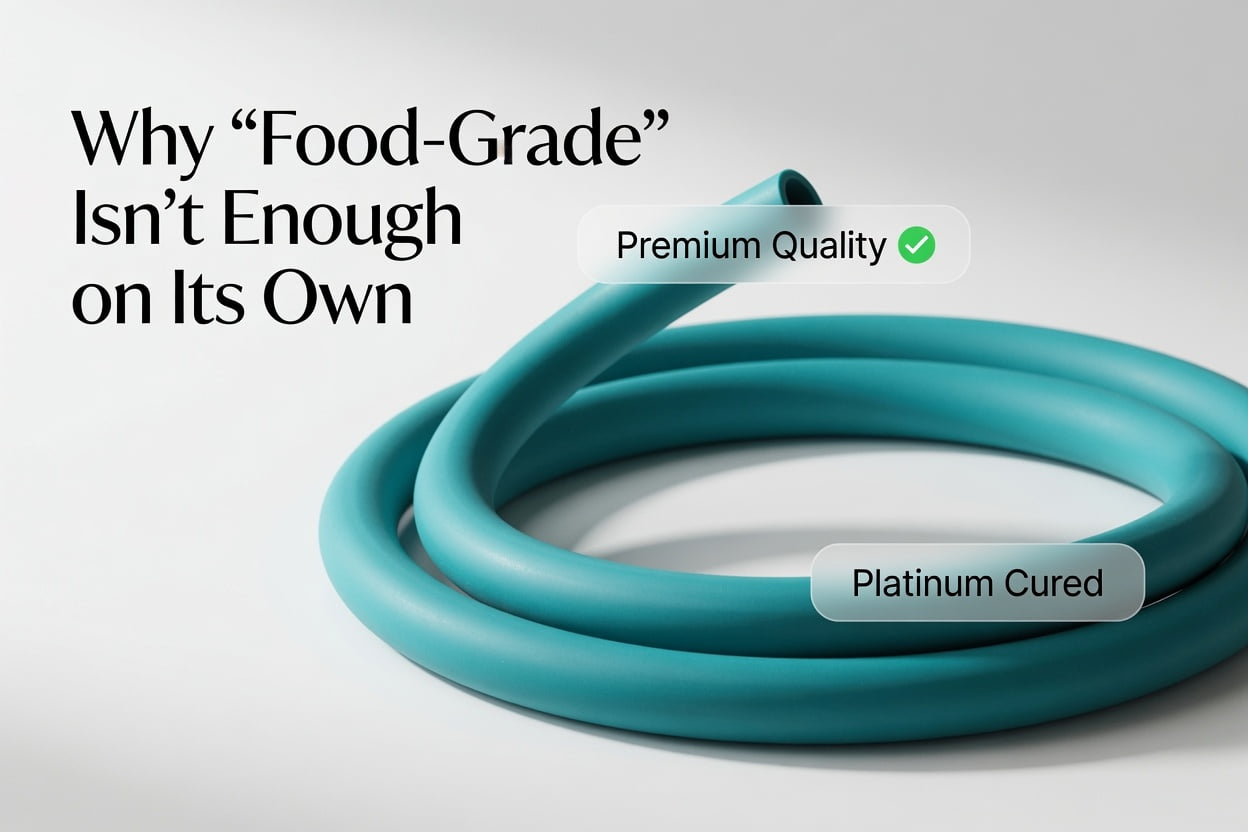
“Food-grade” is a starting line, not the finish. Different markets accept different standards, and not every test covers your exact use. Odor, curing systems, and cleaning behavior still matter. Many buyers learn too late that a generic “FDA” mention doesn’t equal a compliant, low‑odor shisha hose for their market.
No. A food‑grade claim alone does not make a hookah pipe hose the best. Buyers should verify relevant documents (e.g., FDA/LFGB/EC 1935/2004 declarations as required), understand the curing system (platinum vs. peroxide), check odor after unpacking, confirm cleaning performance, and run project‑specific tests or third‑party lab evaluations as needed.
What to verify beyond “food-grade”
- Applicable market standard:
- EU: Often LFGB or EC 1935/2004 food-contact declarations.1
- US: FDA 21 CFR relevant sections for silicone components.2
- Always confirm if the declaration covers the finished article and realistic contact conditions.
- Curing system & odor:
- Platinum-cured silicone generally has lower residual odor vs. peroxide-cured.
- Ask for the curing system, and conduct a simple unpack-and-smell test after 24–48 hours in a closed box.
- Extractables & cleaning:
- Rinse, warm water soak, and mild detergent tests. Check for taste carryover.
- Ensure the hose air-dries without sticking or surface tackiness.
- RoHS/REACH conformity:3
- Important for electronics-adjacent and EU supply chains; not food-contact, but part of due diligence.
- Traceability & lot documents:
- Batch numbers, production dates, and internal test records support complaint handling.
As a silicone hose manufacturer, I supply declarations, material data, and internal QC records upon request and recommend buyers commission third-party testing for their target markets and intended use. In one case, switching a customer from peroxide-cured to platinum-cured stock reduced initial odor complaints in pilot orders and eased their QA sign-off. Your results should be validated by your own tests and documentation needs.
Which hookah pipe dimensions and hardness should I choose?
Bigger isn’t always better. Oversized inner diameter can cause loose connector fits and air leaks. Too thick a wall boosts kink resistance but makes the hose heavy and stiff. Hardness affects grip and bend but also mouthpiece feel. Start from your device’s interfaces and target user preference.
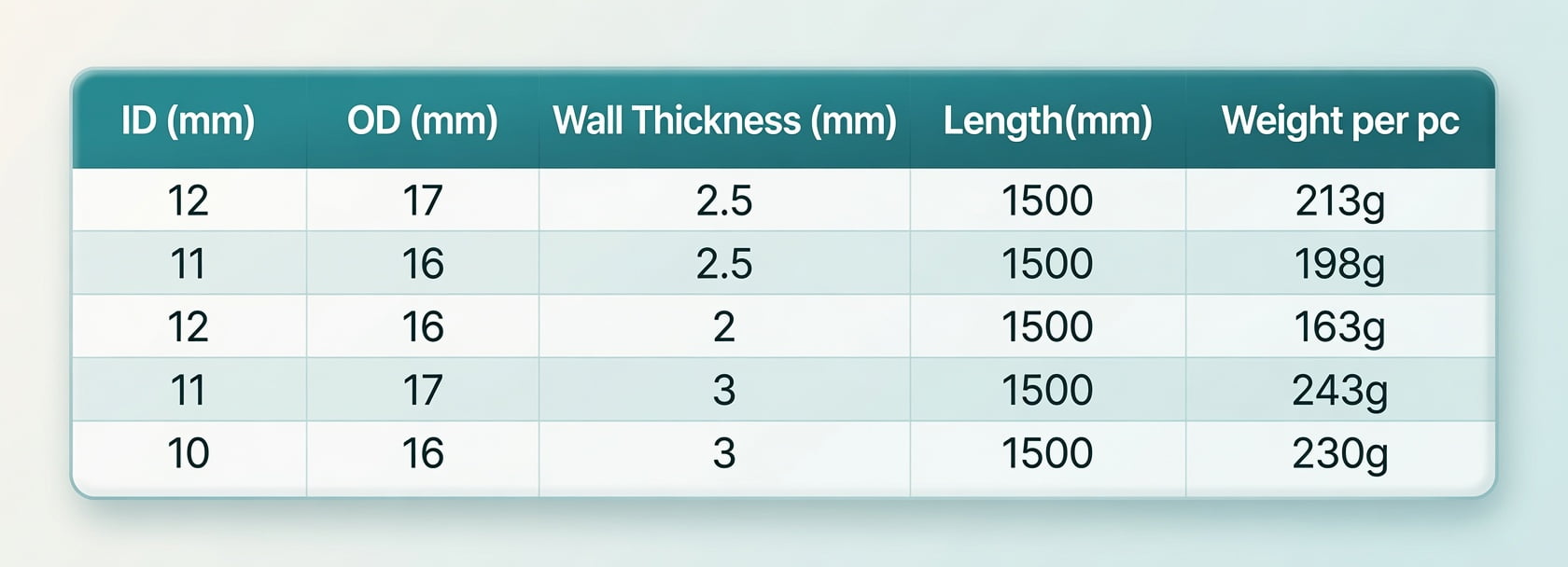
Begin with your mouthpiece and handle interfaces, then define inner diameter (ID), outer diameter (OD), wall thickness, and hardness together. For many hookah pipe hoses, IDs around 10–12 mm and Shore A 50–60 offer a balanced draw and bend. Confirm connector fit, set tolerances, and test bend radius against your target user feel.
Dimension and hardness logic for shisha hoses
- ID/OD basics:
- ID drives airflow and mouthpiece fit. OD drives grip and aesthetic.
- Common ranges I see: ID 9–13 mm; wall 2–4 mm; OD depends on design and sleeve.
- Hardness (Shore A):
- 45–55 Shore A: softer, more flexible, comfortable bend, higher kink risk.
- 55–65 Shore A: firmer, better kink resistance, slightly stiffer feel.
Below is a simple mapping—use it as a starting hypothesis, then sample and adjust:
| Parameter | Lower value tends to… | Higher value tends to… | What to watch |
|---|---|---|---|
| Inner diameter (ID) | Tighter draw, snugger fit | Airier draw, looser fit risk | Match to mouthpiece stem diameter and tolerances |
| Wall thickness | Lighter, more flexible | Heavier, better kink resistance | Shipping weight, user fatigue, bend radius |
| Shore A hardness | Softer touch, easy bend | Firmer feel, resists kinking | Mouthpiece grip compatibility, assembly force |
| OD | Slim profile, light | Chunky, premium look | Sleeve/branding space, carton fit |
- Tolerances matter: For a 12 mm ID hose, a typical extrusion tolerance might be ±0.2–0.3 mm depending on process and inspection plan. Agree on both dimension and hardness tolerances in your spec sheet.
- Interface first: Measure your mouthpiece stem, handle barb, and any adapters. Define the hose ID and wall so the push-fit is secure without overstretching.
- Color & finish: Pigments can slightly affect hardness and surface friction. Always confirm color and gloss/matte finish with the agreed compound and hardness.
In recent samples for a Middle Eastern distributor, we improved connector retention by tightening OD to ±0.2 mm on the end segment and slightly increasing Shore A from 55 to 58. That small change stopped sliding during assembly without making the hose feel stiff during use.
How do I balance flexibility, anti‑kink, and user feel in a hookah pipe hose?
A thick or cheap hose isn’t automatically better. Too thick feels clumsy; too soft kinks and collapses mid-session. Users judge quality by bend during repositioning and whether the hose springs back. Procurement teams judge by damage rates and packaging scuffs. You need a middle ground.
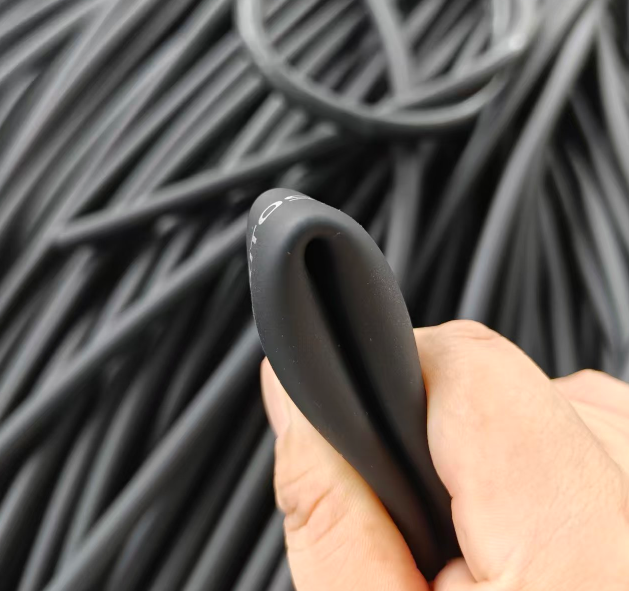
Balance Shore hardness, wall thickness, and diameter to hit a comfortable minimum bend radius without kinking. For many hookah pipe hoses, Shore A 50–60 and wall 2.5–3.5 mm work well. Validate with a simple bend test: loop the hose to target radius, hold 10 seconds, release, and check for collapse or whitening.
Practical ways to tune flexibility and kink resistance
- Minimum bend radius: Define a target, e.g., no collapse at 80–120 mm radius under light handling. Test on every sample batch.
- Hardness-wall tradeoff:
- Slightly softer silicone (+ thinner wall) preserves flexibility but needs careful anti-kink validation.
- Slightly harder silicone (+ moderate wall) resists kinking but risks “rubber-hose” feel.
- Surface finish and feel:
- Matte finishes typically feel drier in hand; glossy can feel tackier.
- Exterior texture can hide scuffs and improve grip in retail handling.
- End treatments:
- Light interference fit at the mouthpiece end can be achieved by tapering or localized OD control.
- Avoid excessive stretching during assembly to prevent micro-tears.
- Anti-kink structures:
- Most hookah hoses are smooth-wall silicone. If you see frequent kinks in your design, consider:
- A modest wall increase at high-bend zones only, or
- A soft internal helix profile as a custom extrusion (adds cost and complexity).
Simple bench test I use during sampling:
- Coil the hose to a predetermined diameter.
- Hold for 10 seconds.
- Release and observe recovery and any whitening at the inner curve.
If whitening or a flat spot remains, we adjust hardness or wall. We also check whether the hose drags on clothing (surface tack) and whether it picks up dust—issues that affect perceived quality on unboxing.
How do I ensure consistent batches and on‑time supply for my hookah pipe program?
Many projects fail at the second or third order when dimensions drift or color shifts. That’s avoidable with clear specs, controlled compounding, and inline inspection. Supplier capacity and traceability also matter. Ask how the factory keeps ID/OD, hardness, and color stable across months of production.
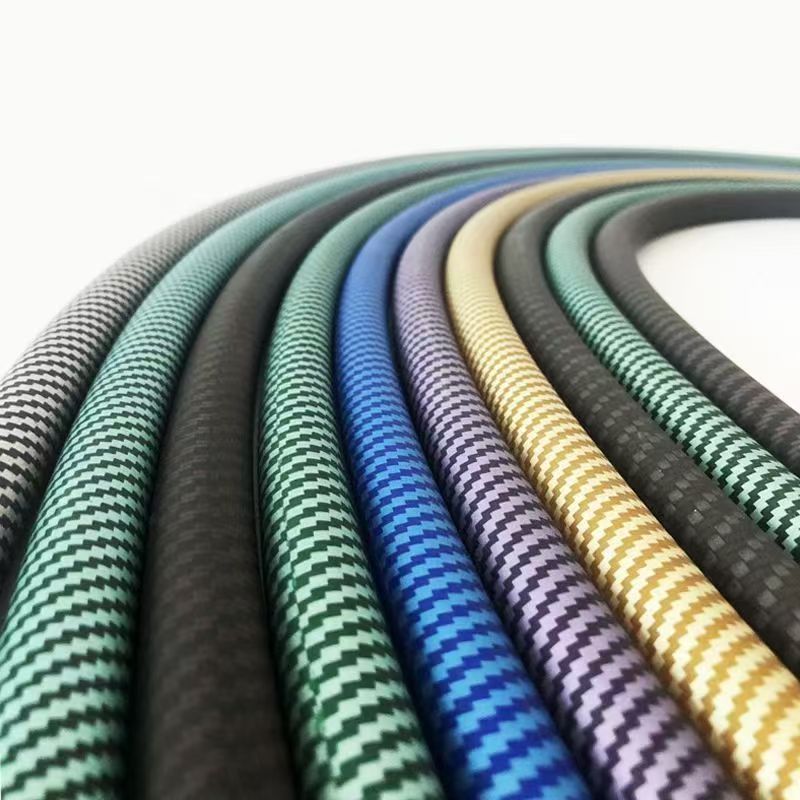
Lock a detailed specification (ID/OD, wall, hardness range, color code, finish, length, packaging), then audit your supplier’s mixing and extrusion controls. For hookah pipe hoses, require batch numbers, CoAs, and incoming inspections. Reconfirm color masterbatch codes for each order. Capacity, tooling, and QC discipline keep repeat orders predictable.
What I recommend and how we run it
- Specification sheet:
- Dimensions with tolerances (e.g., ID 12.0 ±0.2 mm; wall 3.0 ±0.2 mm).
- Hardness range (e.g., 58 ±3 Shore A).
- Color masterbatch code, surface finish, length per piece.
- Packaging (coil diameter, bag type, labels).
- Material and mixing:
- Fix the cure system (platinum-cured for lower odor in many cases).
- Lock pigment supplier and ratio; color shifts often come from substitution.
- Record compound batch numbers for traceability.
- Inline and final QC:
- Measure ID/OD at defined intervals (e.g., every 100 m).
- Durometer checks per lot.
- Visual inspection for surface defects and color consistency.
- Odor spot-checks after 24-hour enclosure.
- Documentation to request:
- ISO 9001 (quality management) certificate.4
- Food-contact declarations relevant to your market (e.g., FDA/LFGB/EC 1935/2004) for the silicone materials/finished hose as applicable.
- RoHS/REACH conformity where required.
- Certificate of Analysis (CoA) per batch5 with key measurements.
- Lot and date codes on packaging.
- Capacity and scheduling:
- Confirm extrusion line availability, mold or die maintenance plan, and lead times.
- Agree on buffers for color changes and peak seasons.
At Taixing Haiwang Silicone Products Co., Ltd., we run 20 extrusion lines with batch traceability and in-process measurement. That capacity lets me keep stable delivery on multi-color programs and tighten tolerances when a customer’s handle design demands it. We supply documents on request and encourage buyers to verify them and commission third-party testing as needed for their markets.
Frequently Asked Questions
What inner diameter is most popular for a hookah pipe hose?
I most often see 10–12 mm ID requested because it balances an easy draw with connector compatibility. However, your mouthpiece and handle stem size should drive the final ID. Always measure your mating parts and validate the fit with a sample before confirming mass production.
Is platinum‑cured silicone always better for hookah hoses?
Platinum‑cured silicone typically has lower residual odor and better clarity than peroxide‑cured silicone6, which many buyers prefer for hookah hoses. “Better” depends on your cost target and odor tolerance. If you sell into sensitive markets, platinum cure is often worth it, but confirm with your own tests.
How can I check odor before ordering a full batch?
Do an unpack test. Seal three sample hoses in a clean box for 24–48 hours. Open and assess odor immediately, then after a quick warm water rinse. If odor persists or transfers to water noticeably, discuss cure system and post‑curing adjustments and consider third‑party testing.
What documents prove a hookah hose is food‑contact suitable?
Ask for relevant food‑contact declarations for your market (e.g., FDA, LFGB, EC 1935/2004), plus RoHS/REACH where required. Ensure the declaration matches the finished hose or the specific silicone material used and its intended contact conditions. Verify documents and, if necessary, commission external lab tests.
How tight should dimension tolerances be on silicone hoses?
It depends on your connector design. For many hookah hoses around 12 mm ID, ±0.2–0.3 mm on ID and wall thickness is workable with robust in‑process control. If your handle fit is sensitive, tighten tolerance and increase inspection frequency. Confirm the supplier can hold the agreed range consistently.
Conclusion
The best hookah pipe for a brand or importer is the one that minimizes procurement risk: a food‑grade silicone hose with controlled odor, the right compliance paperwork for your market, stable dimensions and hardness, clean connector fit, and dependable batch repeatability. If you want a fast start, ask me for a spec sheet template, sample recommendations by market, and a pilot run plan—then verify with your tests and documents before launch.
"Legislation - Food Safety - European Commission", https://food.ec.europa.eu/food-safety/chemical-safety/food-contact-materials/legislation_en. European Union materials-on-food-contact guidance identifies Regulation (EC) No 1935/2004 as the overarching legal framework, and German authorities (LFGB/BfR) issue national recommendations that are often cited for compliance in Germany. Evidence role: definition; source type: government. Supports: That EC 1935/2004 is the EU’s general framework for materials intended to come into contact with food, and that Germany’s LFGB/BfR recommendations are used nationally within that framework.. Scope note: The source explains the legal framework; it does not confirm usage patterns for hookah hoses specifically. ↩
"21 CFR 177.2600 -- Rubber articles intended for repeated ...", https://www.ecfr.gov/current/title-21/chapter-I/subchapter-B/part-177/subpart-C/section-177.2600. U.S. FDA regulations at 21 CFR 177.2600 specify requirements for rubber articles intended for repeated use in contact with food, which encompasses silicone elastomer components when used under the prescribed conditions. Evidence role: definition; source type: government. Supports: That 21 CFR 177.2600 governs rubber articles intended for repeated use in food-contact applications, a category that includes many silicone elastomer components.. Scope note: Applicability depends on the exact formulation and intended conditions of use of the finished hose. ↩
"EU REACH", https://www.trade.gov/eu-reach. European authorities describe RoHS as a directive limiting certain substances in electrical and electronic equipment and REACH as a regulation on chemical substances and their safe use, distinct from the EU’s food-contact framework. Evidence role: definition; source type: government. Supports: That RoHS restricts hazardous substances in electrical and electronic equipment and that REACH governs chemical substances placed on the EU market, neither of which is a food-contact regulation.. Scope note: While not food-contact regulations, customers may still require RoHS/REACH conformity for supply-chain or market access reasons. ↩
"ISO 9000 family", https://en.wikipedia.org/wiki/ISO_9000_family. ISO 9001 is described as an international standard that sets out the criteria for quality management systems focused on consistent processes and continual improvement. Evidence role: definition; source type: encyclopedia. Supports: That ISO 9001 is an international standard specifying requirements for a quality management system.. Scope note: Certification to ISO 9001 concerns management systems and does not guarantee the quality of any specific product lot. ↩
"Certificate of analysis", https://en.wikipedia.org/wiki/Certificate_of_analysis. A certificate of analysis is defined as a document issued by a supplier that reports specific test results and specifications for a particular batch of material or product. Evidence role: definition; source type: encyclopedia. Supports: What a Certificate of Analysis is and its role as a document reporting test results/specifications for a specific batch.. Scope note: The definition is general and does not prescribe which measurements a hookah hose CoA must include. ↩
"Silicone rubber", https://en.wikipedia.org/wiki/Silicone_rubber. General references describe addition‑cure liquid silicone rubber being used for transparent and optical components, supporting the view that such systems can achieve high clarity compared with peroxide‑cured formulations. Evidence role: general_support; source type: encyclopedia. Supports: That addition‑cure liquid silicone rubber is used for transparent/optical applications, indicating higher achievable clarity compared with some other silicone curing systems.. Scope note: This is contextual support based on typical applications; it does not directly compare clarity across all specific peroxide‑cured and platinum‑cured compounds. ↩

发表回复