Inflatable Seals for a Nuclear Plant Application: What Should Buyers Evaluate First?
Inflatable seals for a nuclear plant application can look like a normal custom silicone RFQ at first. The problem is that the real risk is often hidden in the application boundary. If buyers only ask, “Can you make this size?”, they may miss safety classification, operating conditions, documentation, and approval requirements.
Inflatable seals for a nuclear plant application should be evaluated first by use location, sealing function, failure consequence, operating conditions, and required approval route. A supplier can help review manufacturability, groove design, material fit, inflation behavior, and test needs, but final nuclear safety classification and project approval must come from the project owner or qualified authority.
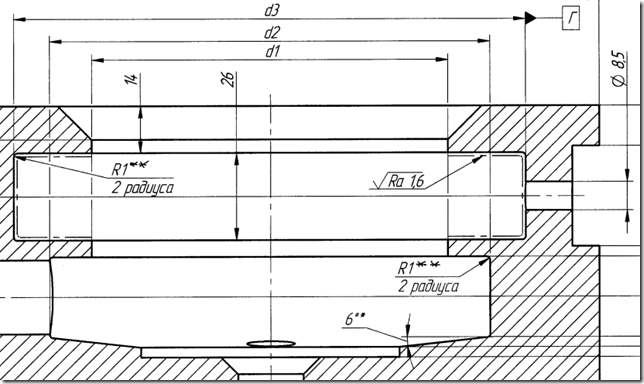
In my experience with high-requirement inflatable seal inquiries, the responsible answer is rarely a quick price. I first need to understand the interface, pressure, temperature, media, expansion space, and documentation expectations. Only then can I help decide whether the project is technically assessable.
Why Are Inflatable Seals for a Nuclear Plant Application Different From Ordinary Industrial Seals?
A buyer may assume that inflatable silicone seals are mainly about size, hardness, and price. That assumption creates risk. In demanding plant equipment, the seal may affect isolation, leakage control, maintenance access, or equipment reliability.
Inflatable seals for a nuclear plant application are different because the buyer must evaluate failure consequence, operating environment, documentation, and project approval before normal manufacturing feasibility1. The question is not only “Can the seal be made?” It is also “Can this seal be justified, tested, documented, and accepted for this exact boundary?”
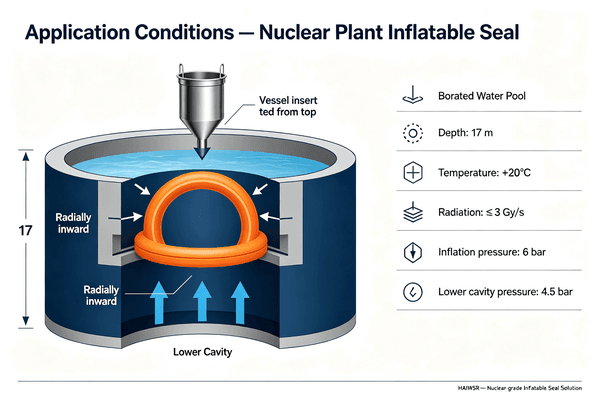
The first question is application boundary, not production ability
At Haiwang Silicone, I have seen buyers send a drawing and ask for a fast quote for a custom inflatable seal. For many industrial projects, that can be enough to start a basic feasibility review. For a nuclear-related project, it is not enough.
A responsible supplier needs to understand where the seal will be installed and what happens if it fails. This does not mean the supplier becomes the nuclear authority. It means the supplier must avoid treating a high-risk seal like a general factory spare part.
Useful first questions include:
Where is the seal used?
Is it inside process equipment, an access door, a containment-related interface, a transport fixture, a maintenance system, or a non-safety auxiliary machine?What does the seal contain or exclude?
The media may be air, water, steam, chemicals, dust, shielding-related environments, or other plant-specific exposure conditions.What is the failure consequence?
The project owner must define this. A leak in a temporary dust cover is not the same as a leak in a critical isolation boundary.Who approves the seal?
Procurement, engineering, QA, the OEM integrator, the end user, or a regulatory body may all have different review responsibilities.
Ordinary industrial assumptions can mislead buyers
A silicone inflatable seal used in packaging equipment, food machinery, or industrial doors may be selected mainly by dimensions, elasticity, inflation pressure, and sealing surface. Those factors still matter, but they are not enough for nuclear plant equipment.
Here is a simple comparison:
| Evaluation item | Ordinary industrial seal | Nuclear plant-related seal inquiry |
|---|---|---|
| Main focus | Fit, price, delivery, durability | Risk boundary, documentation, approval route |
| Drawing review | Often enough to quote | Usually only the starting point |
| Material certificate | Helpful | Must match project-specific requirements |
| Supplier role | Manufacturer and technical support | Manufacturer, feasibility reviewer, document provider |
| Final approval | Buyer or equipment OEM | Project owner, qualified authority, or defined approval body |
Certifications must be understood correctly
Haiwang Silicone works with materials and quality systems supported by documents such as FDA, LFGB, ISO 9001, RoHS, and REACH, depending on the product and requested material. These can be valuable for buyer screening.
However, I would not present these documents as proof that inflatable seals for a nuclear plant application are automatically acceptable. They are not nuclear project approvals.2 They support specific aspects, such as food-contact compliance, restricted substances, or quality management. The buyer still needs project-specific review.
A seal supplier can help evaluate structure, manufacturability, and material fit based on supplied conditions. The project owner or qualified authority must determine nuclear safety classification and acceptance.
What RFQ Inputs Are Needed for Inflatable Seals for a Nuclear Plant Application?
A vague RFQ slows everything down. It also increases the chance of a wrong technical assumption. If the buyer only sends an outer diameter and asks for “nuclear plant use,” the supplier cannot evaluate the real sealing challenge.
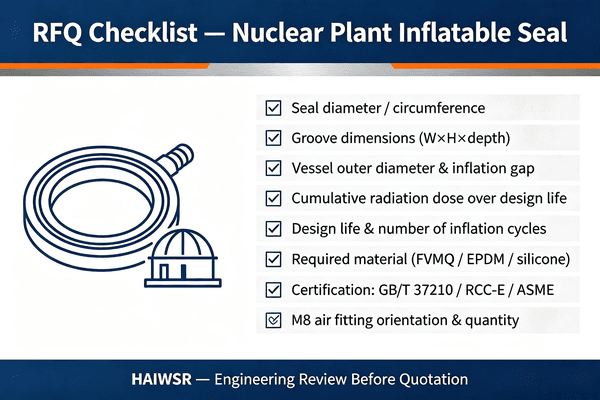
For inflatable seals for a nuclear plant application, the RFQ should include drawings, groove dimensions, expansion space, compression target, inflation pressure, operating temperature, system pressure, media, radiation exposure, cleanliness needs, service cycle, and documentation requirements.3 These inputs help the supplier assess feasibility without making unsupported approval claims.
Minimum information I ask for before quoting
When I review a custom inflatable silicone seal inquiry, I try to separate what is known, what is assumed, and what must be confirmed by the buyer’s engineering team. This protects both sides.
A practical RFQ package should include:
- 2D drawing and 3D model, if available
- Seal cross-section and tolerance requirements
- Groove or channel dimensions
- Available expansion space
- Sealing surface material and finish
- Target compression or contact pressure
- Inflation pressure range
- Operating pressure outside the seal
- Temperature range
- Media exposure
- Radiation exposure, if applicable and quantified by the project team
- Expected service life or cycle count
- Cleanliness or packaging requirements
- Test standards or project test procedure
- Traceability and document package requirements
- Safety classification or approval boundary, as defined by the project owner
If these details are missing, a quotation may only be a rough commercial reference. It should not be treated as a technical approval.
Key design inputs and why they matter
| RFQ input | Why it matters for evaluation |
|---|---|
| Groove width and depth4 | Controls seal retention and inflation direction |
| Expansion space | Prevents over-expansion, folding, or extrusion |
| Inflation pressure | Affects contact force and fatigue behavior |
| Compression target | Determines whether the seal can close the gap reliably |
| Temperature | Influences silicone elasticity and aging |
| Media | Determines material compatibility risks |
| Radiation exposure | Requires project-specific material review |
| Surface finish | Affects leakage path and seal wear |
| Cycle count | Influences fatigue and validation testing |
| Documentation | Determines whether supplier records are enough for procurement |
Manufacturing review is practical, not theoretical
For custom inflatable seals, manufacturability depends on the relationship between the seal geometry and the working space. A beautiful drawing can still fail if the inflated shape has nowhere to expand. A strong material can still leak if the sealing land is too narrow or uneven.
In my factory communication, I usually review questions such as:
- Can the seal be produced with stable wall thickness?
- Can the air inlet be molded or bonded without creating a weak point?
- Will the seal inflate toward the intended sealing surface?
- Is the groove deep enough to hold the seal before inflation?
- Is the corner radius friendly to silicone forming?
- Can the part be inspected with repeatable criteria?
- Can samples be tested against the buyer’s interface?
Haiwang Silicone has in-house mold design and CNC tooling, and we regularly support custom silicone profiles, molded parts, tubing, and inflatable seals. Still, for nuclear plant-related use, I would describe our role carefully: we can help evaluate manufacturability and material fit based on supplied conditions. We cannot replace the project’s engineering authority or regulatory approval process.
How Should Buyers Separate Manufacturing Capability, Material Suitability, and Nuclear Project Approval?
Many procurement problems happen because different approval layers get mixed together. A supplier may be able to make the geometry. The material may appear suitable for some conditions. But the project may still require a separate qualification route.
Buyers should separate inflatable seals for a nuclear plant application into three layers: manufacturing capability, material suitability, and nuclear project approval. A silicone manufacturer can support the first two with drawings, samples, tests, and documents. The final safety classification, compliance judgment, and project acceptance must remain with the project owner or qualified authority.
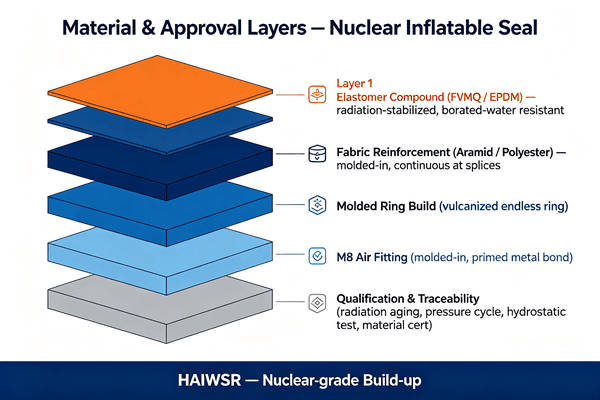
Layer 1: Manufacturing capability
Manufacturing capability asks a practical question: Can the supplier make this part repeatedly and inspect it properly?
For an inflatable silicone seal, this includes:
- Cross-section stability
- Bonding or molding quality
- Air inlet design
- Dimensional tolerance
- Surface quality
- Batch consistency
- Tooling feasibility
- Sample lead time
- Test fixture planning
At Haiwang Silicone, our 15,000㎡ factory in Taixing, China supports custom silicone extrusion, molding, in-house mold design, and CNC tooling. That background helps us review unusual inflatable seal structures. However, capability to manufacture does not equal project approval.
Layer 2: Material suitability
Material suitability asks another question: Can the selected silicone compound tolerate the stated conditions?
This depends on temperature, media, aging, mechanical load, cycle count, and any project-defined exposure conditions. For example, silicone can perform well in many industrial sealing applications because it offers flexibility, thermal stability, and good compression recovery5. But a nuclear plant-related application may involve additional environmental or documentation requirements.
Common material-related review points include:
| Material factor | Buyer should confirm |
|---|---|
| Temperature range | Continuous and peak exposure |
| Media compatibility | Water, air, steam, chemicals, cleaning agents |
| Mechanical stress | Inflation cycles, compression, stretching |
| Aging conditions | Heat aging, ozone, UV, storage time |
| Radiation exposure | Dose, dose rate, location, and project acceptance criteria |
| Cleanliness | Particles, release agents, packaging, handling |
| Traceability | Batch records and material certificates |
A supplier can provide material data and test support. The buyer’s technical team must decide whether that evidence fits the application.
Layer 3: Nuclear project approval
Nuclear project approval asks the final question: Is this seal acceptable under the project’s safety, regulatory, and quality requirements?
This layer may include safety classification, procurement code requirements, end-user specifications, QA documentation, inspection hold points, third-party review, or site-specific acceptance. The exact route depends on the country, plant, system, and project owner.
I would not claim that FDA, LFGB, ISO 9001, RoHS, or REACH documentation proves suitability for a nuclear plant application. These documents may support supplier credibility, but they do not replace nuclear project qualification.
A simple decision map for procurement
Procurement teams can use this sequence before requesting price:
Define application boundary
Ask where the seal is used and what it must prevent.Define failure consequence
Ask the project owner or responsible engineer to classify the risk.Confirm approval route
Identify who can approve the seal and what documents are required.Prepare technical RFQ data
Send drawings, conditions, test expectations, and documentation needs.Ask supplier for feasibility review
Request comments on groove design, inflation behavior, tooling, and sample testing.Run sample and validation testing
Test the seal in the actual or simulated interface.Submit documents for project approval
Keep the approval decision with the qualified authority.
This separation saves time. It also prevents a low-price quotation from being mistaken for engineering acceptance.
What Design Risks Should Buyers Check Before Ordering a Custom Inflatable Seal?
A custom inflatable seal can look simple because it is soft and flexible. But the design can fail in small details. A narrow groove, sharp corner, poor inlet location, or wrong inflation pressure can create leakage or early damage.
Before ordering inflatable seals for a nuclear plant application, buyers should check groove design, expansion direction, sealing surface quality, inflation pressure control, compression target, inlet strength, fatigue behavior, and test method. These risks should be reviewed before tooling, because late design changes can be expensive and slow.
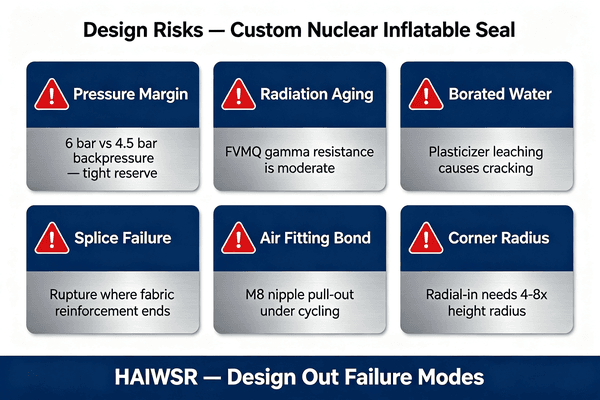
Groove and expansion space
An inflatable seal needs controlled space. If the groove is too tight, the seal may not inflate correctly. If the groove is too loose, the seal may roll, twist, or move under pressure.
Key groove questions include:
- Is the groove deep enough to retain the seal before inflation?
- Is the groove wide enough for expansion without pinching?
- Does the design prevent extrusion under pressure?
- Are the groove corners rounded enough for silicone?
- Is the sealing surface aligned with the inflation direction?
For procurement, I always prefer to see the groove drawing together with the seal drawing. A seal drawing alone may hide the most important design problem.
Inflation behavior and pressure control
The inflation pressure must be high enough to create sealing contact, but not so high that it damages the seal or interface.6 The buyer should define both normal pressure and maximum allowable pressure.
A practical review should include:
| Risk | Possible result | Preventive action |
|---|---|---|
| Over-inflation | Bulging, tearing, shortened life | Define pressure limit and test range |
| Under-inflation | Leakage or weak contact | Define contact target and leakage test |
| Uneven expansion | Local leakage | Review wall thickness and groove support |
| Poor inlet design | Air leakage or joint failure | Strengthen inlet and inspect bonding |
| Sharp interface | Cutting or abrasion | Add radius or improve finish |
Sealing surface and leakage path
A soft seal cannot solve every interface problem. If the mating surface is rough, warped, contaminated, or discontinuous, leakage can occur even when the seal itself is well made.
Buyers should confirm:
- Surface roughness requirements
- Flatness or roundness tolerance
- Joint gaps or weld seams
- Coating compatibility
- Cleaning procedure
- Assembly alignment
In many projects, the seal supplier can suggest improvements, but the equipment designer must decide whether the interface can be changed.
Testing should match real use
A simple air leak test may be useful, but it may not represent the real operating condition. For high-requirement applications, buyers often need a test plan that reflects the actual interface and duty cycle.
Possible tests include:
- Dimensional inspection
- Inflation pressure holding test
- Leakage test in fixture
- Compression or contact verification
- Cycle test
- Heat aging test
- Media exposure test
- Packaging and cleanliness inspection
- Traceability review
The test plan should come from the buyer’s engineering and quality teams. The supplier can support sample production and agreed inspection data. For nuclear plant-related procurement, the acceptance criteria should not be guessed by the manufacturer.
How Should Procurement Teams Screen a Supplier for Inflatable Seals for a Nuclear Plant Application?
A supplier search can become confusing because many companies can say, “Yes, we make silicone seals.” That answer is not enough. For high-requirement equipment, buyers need to evaluate communication quality, technical review ability, tooling control, documentation discipline, and willingness to respect approval boundaries.
Procurement teams should screen suppliers by checking custom inflatable seal experience, drawing review capability, material documentation, tooling process, sample testing support, export experience, and quality records. For inflatable seals for a nuclear plant application, buyers should also prefer suppliers who clearly state what they can and cannot approve.
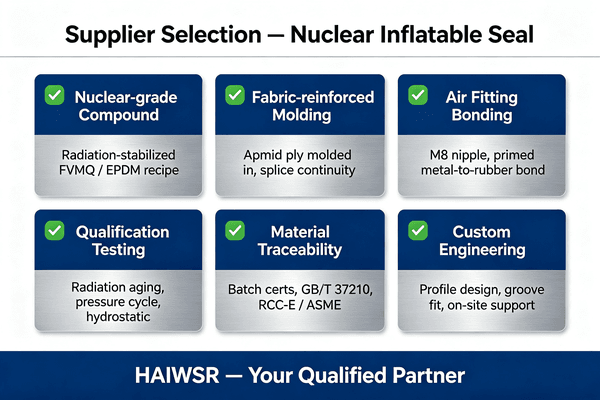
What a responsible supplier should ask
A capable supplier should not rush straight to price. They should ask technical questions that reduce risk.
When I handle specialized inflatable seal inquiries, I usually expect discussion around:
- Application location
- Safety or non-safety classification, as defined by the buyer
- Drawing revision control
- Groove and interface dimensions
- Inflation method
- Operating and test pressure
- Temperature range
- Media exposure
- Expected cycle life
- Sample test plan
- Required certificates and records
- Packaging, labeling, and export requirements
These questions may feel slow at first. In practice, they save time because they prevent wrong material selection, wrong tooling, and incomplete documentation.
Supplier evaluation checklist
| Screening area | What buyers should look for |
|---|---|
| Technical communication | Clear questions before quote |
| Custom tooling | Ability to build or adjust molds |
| Silicone processing | Experience with molding, bonding, extrusion, or profile forming |
| Documentation | Material certificates, inspection records, batch traceability |
| Quality system | ISO 9001 or similar management evidence |
| Export experience | Familiarity with overseas B2B requirements |
| Sample support | Willingness to make prototypes and revise |
| Boundary discipline | No unsupported nuclear-grade claims |
Haiwang Silicone was established in 2004 and exports silicone products worldwide. Our product range includes food-grade and industrial silicone tubing, sealing strips, extruded profiles, molded silicone parts, and inflatable silicone seals. We also support custom sizes, drawings, and tooling, with a typical MOQ of 50 kg and free quotation support within 24 hours after receiving enough RFQ data.
That said, I would still tell a nuclear-related buyer the same thing: our team can help review manufacturability, material options, sample production, and documentation support. The buyer’s project authority must confirm final suitability and approval.
Red flags during supplier selection
Procurement teams should be cautious if a supplier:
- Claims “nuclear-grade” without project-specific evidence
- Treats FDA or LFGB as nuclear approval
- Quotes without asking for operating conditions
- Ignores groove design and expansion space
- Cannot discuss inflation pressure or sealing direction
- Refuses sample testing
- Cannot provide traceable production records
- Gives absolute guarantees without knowing the application
A cautious supplier is not necessarily a slow supplier. Often, caution is a sign that the supplier understands the risk boundary.
Frequently Asked Questions
Can silicone inflatable seals be used in nuclear plant equipment?
Silicone inflatable seals may be technically assessable for some nuclear plant-related equipment, depending on location, exposure, duty, and approval requirements. A supplier can review manufacturability and material fit, but the project owner or qualified authority must decide whether the seal is acceptable for that specific use.
Do FDA, LFGB, ISO 9001, RoHS, or REACH prove nuclear suitability?
No. These documents may support material compliance, restricted substance control, or quality management credibility. They do not prove that inflatable seals for a nuclear plant application are approved, qualified, or suitable. Nuclear project acceptance requires project-specific review and approval.
What drawings should I send for a custom inflatable seal quotation?
You should send the seal drawing, groove drawing, mating interface drawing, target dimensions, tolerances, inflation port details, and any 3D model available. You should also provide pressure, temperature, media, expansion space, cycle life, and required test or documentation standards.
Can a supplier decide the nuclear safety class of the seal?
No. A silicone seal supplier should not decide the nuclear safety class. The project owner, qualified engineering authority, or responsible regulatory route must define classification and approval requirements. The supplier can only support technical review, samples, testing data, and manufacturing documents.
How long does a custom inflatable seal project usually take?
For general custom silicone projects, buyers often move from inquiry to order in about 2–6 weeks, depending on drawing clarity, tooling needs, sample testing, and approval steps. Nuclear plant-related applications may take longer because documentation, validation, and authority review can add time.
Conclusion
Inflatable seals for a nuclear plant application should never be treated as a simple size-and-price inquiry. Buyers need to define the use location, failure consequence, operating conditions, RFQ inputs, documentation needs, and approval route before judging supplier capability. I can help evaluate custom silicone inflatable seal manufacturability, material options, tooling feasibility, and sample support based on your drawings and conditions. If you are preparing a specialized RFQ, send your drawings and technical requirements to Haiwang Silicone for a careful feasibility review and quotation.
"Appendix B to Part 50, Title 10 -- Quality Assurance Criteria ...", https://www.ecfr.gov/current/title-10/chapter-I/part-50/subject-group-ECFR89aa6ca4aada73c/appendix-Appendix%20B%20to%20Part%2050. IAEA and NRC quality-assurance guidance for nuclear facilities links procurement, documentation, and controls to the safety significance and service conditions of items, providing contextual support for evaluating these factors before routine manufacturing feasibility. Evidence role: general_support; source type: institution. Supports: The source should support that nuclear plant components are evaluated according to safety significance, service conditions, documentation, and quality requirements.. Scope note: The support is contextual because the guidance addresses nuclear items broadly, not inflatable silicone seals specifically. ↩
"Inventory of Food Contact Substances Listed in 21 CFR", https://www.hfpappexternal.fda.gov/scripts/fdcc/index.cfm?search=silicone&set=IndirectAdditives. Official descriptions of ISO 9001, FDA food-contact regulation, and EU chemical-restriction regimes show that these instruments address quality management, food-contact or substance-control requirements, not nuclear safety qualification. Evidence role: definition; source type: institution. Supports: The source should define the scope of FDA food-contact rules, REACH/RoHS substance controls, and ISO 9001 quality management so readers can see they are not nuclear approvals.. Scope note: This supports the negative distinction by scope comparison; it does not identify the complete approval route for any specific nuclear project. ↩
"An Overview of Advanced Elastomeric Seal Development ...", https://ntrs.nasa.gov/api/citations/20140017051/downloads/20140017051.pdf. Engineering seal-design references identify geometry, compression, pressure, temperature, media compatibility, service conditions, and inspection requirements as key inputs for elastomer seal selection and validation. Evidence role: general_support; source type: research. Supports: The source should support that seal design and procurement require defined geometry, pressure, temperature, media exposure, service duty, and documentation or testing criteria.. Scope note: This would support the RFQ checklist as engineering context; it may not address every nuclear documentation requirement listed in the article. ↩
"Vacuum Seals Design Criteria", https://llis.nasa.gov/lesson/674. Elastomer seal-design guidance explains that gland dimensions govern seal retention, compression, available deformation space, and extrusion risk, supporting the article’s emphasis on groove width and depth. Evidence role: mechanism; source type: research. Supports: The source should support that groove or gland geometry affects elastomer seal retention, compression, expansion space, and extrusion risk.. Scope note: Most general seal-design guidance is not specific to inflatable seals, so it supports the design principle rather than a complete inflatable-seal calculation. ↩
"Silicone rubber", https://en.wikipedia.org/wiki/Silicone_rubber. Materials references describe silicone rubber as an elastomer valued for flexibility and resistance to a wide temperature range, with compression-set behavior relevant to sealing applications. Evidence role: definition; source type: encyclopedia. Supports: The source should support general silicone rubber properties relevant to sealing, including flexibility, temperature resistance, and compression behavior.. Scope note: The source would support general material properties, not suitability for a particular nuclear plant location. ↩
"Parker O-ring Handbook", https://wp.optics.arizona.edu/optomech/wp-content/uploads/sites/53/2016/10/Parker-O-ring-handbook.pdf. Seal-design literature explains that elastomer seals require sufficient contact stress to block leakage, while excessive pressure or deformation can increase extrusion, tearing, or wear risk. Evidence role: mechanism; source type: research. Supports: The source should support that seal performance depends on sufficient contact pressure while excessive deformation or pressure can damage elastomers or mating surfaces.. Scope note: This supports the general mechanical principle; exact pressure limits require the specific seal geometry, material, and interface. ↩
发表回复