
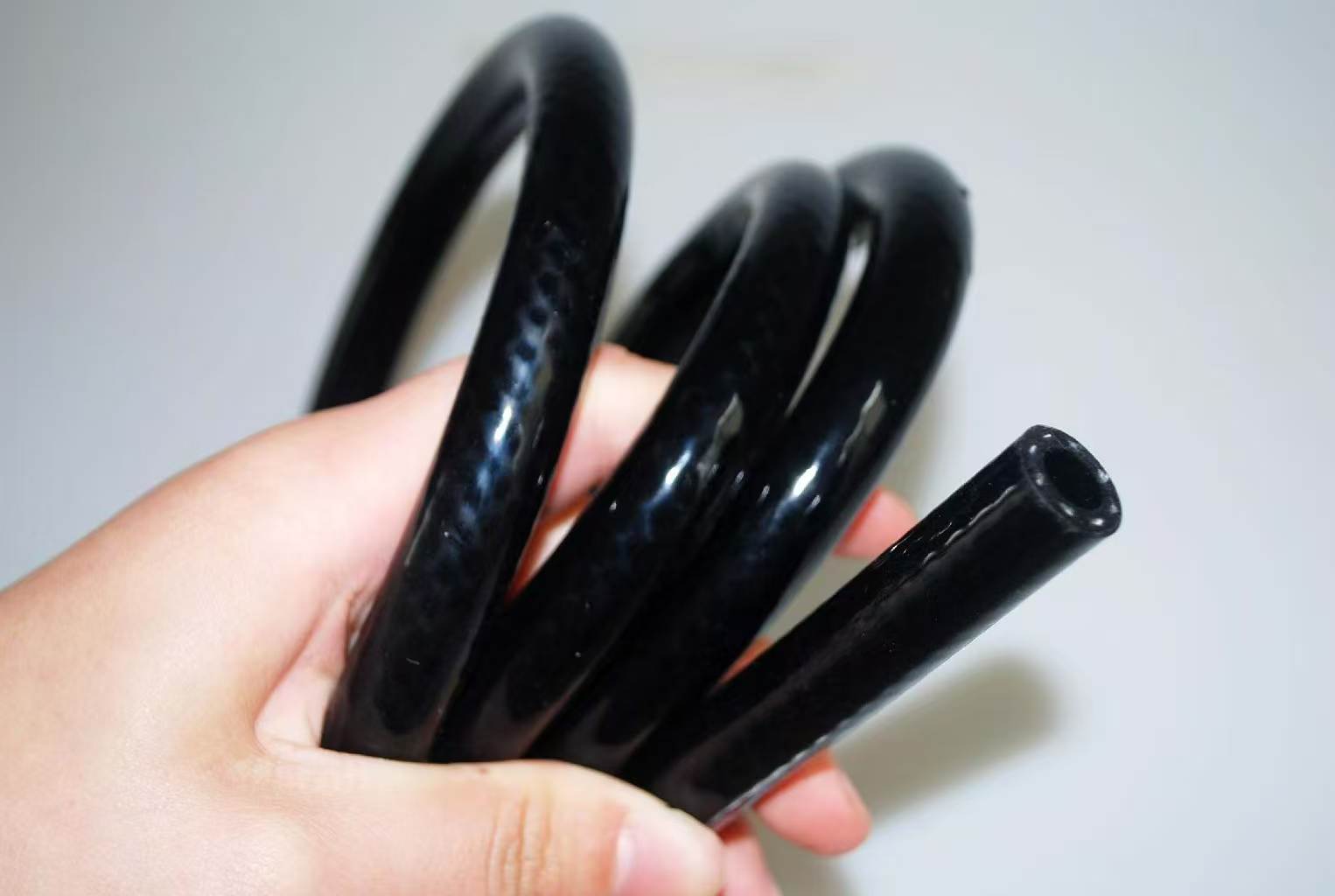
A silicone hose often looks like a strong choice because it handles heat, stays flexible, and feels durable. The problem starts when buyers assume heat resistance equals fuel resistance. Gasoline can create swelling, softening, permeation, and leak risks, so the safer solution is verified fuel-compatible hose selection.
A regular silicone hose is not recommended for long-term gasoline transfer.1 It may survive brief accidental contact, but that does not prove reliable service. Gasoline compatibility depends on the exact fuel blend, contact time, temperature, pressure, bend radius, and pump conditions.2 I always recommend confirming fuel-compatible hose specifications before use.
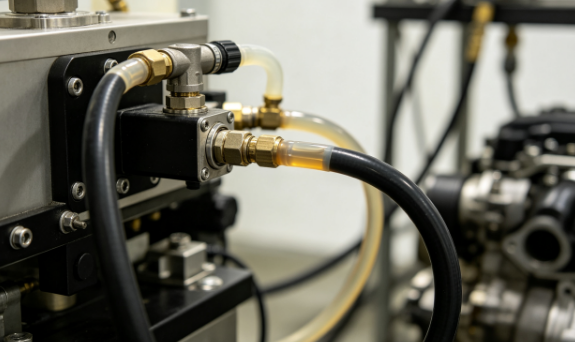
I have seen this question come up often in customer consultations. A buyer finds a clean, flexible, high-temperature hose and thinks it should work for fuel. However, hose selection is not about one good property. It is about the full service environment.
Can a silicone hose handle gasoline for short contact?
A silicone hose may see gasoline during filling, maintenance, or accidental splashing. That sounds harmless at first. The concern is that “no immediate leak” can create false confidence. If the same hose later sees repeated exposure, the risk can increase quickly.
A regular silicone hose may tolerate brief incidental gasoline contact without instant failure, but I would not treat that as proof of compatibility. Short contact, wiping, and room-temperature exposure are very different from continuous fuel transfer, immersion, pressure, heat, vibration, or pump pulsation.

Short contact is not the same as service duty
When I talk with buyers, I usually ask one simple question first: What does “contact with gasoline” actually mean? The answer changes everything. Some people mean a splash during refueling. Others mean a drain line. Some mean a small-engine fuel line. Others mean a transfer hose that carries gasoline every day.
Those are not the same application.
Here is how I usually separate the risk levels:
| Gasoline exposure type | Typical situation | Risk level for regular silicone hose | My supplier-side recommendation |
|---|---|---|---|
| Accidental splash | Fuel spilled during maintenance | Lower | Clean quickly and inspect |
| Occasional vapor/contact | Nearby fuel area or vent exposure | Medium | Confirm material compatibility |
| Intermittent transfer | Fuel passes through hose sometimes | High | Use verified fuel hose |
| Continuous transfer | Regular fuel line or pump line | Very high | Do not use regular silicone hose |
| Long-term immersion | Hose sits in gasoline | Very high | Use a material designed for fuel immersion |
The biggest mistake is using a simple “test” like this:
“I put gasoline in the hose for one hour, and it did not leak.”
I understand why people do it. It feels practical. However, it does not represent real service. In actual use, the hose may face:
- Higher temperature
- Internal pressure
- Vacuum or suction
- Bending stress
- Engine vibration
- Pump pulsation
- Fuel additives
- Repeated wet-dry cycles
- Long-term permeation
Gasoline is not one simple chemical.3 Commercial gasoline may contain hydrocarbons, aromatics, oxygenates, ethanol blends such as E10 or E15, detergents, and regional additive packages.4 These variables can change how rubber and elastomer materials behave.
For ordinary silicone, the problem is not usually immediate cracking like a brittle plastic. The concern is more practical and gradual. Gasoline exposure may cause:
Swelling
The hose dimensions may change, which can loosen clamps or affect fit.Softening
The hose may lose mechanical strength and kink more easily.Permeation
Fuel or vapor may pass through the hose wall over time.Loss of sealing force
The connection may look tight but become unreliable.Leakage risk
Fuel leakage creates safety, downtime, and replacement-cost problems.
In my factory conversations, I often remind customers that silicone is excellent in many environments. It is widely used for heat-resistant air ducts, appliance seals, medical tubing, food-contact tubing, and custom industrial profiles. However, those strengths do not automatically make it a gasoline transfer material.
If the exposure is only accidental, I would clean the hose and inspect it. If the exposure is repeated or functional, I would move to a fuel-compatible hose specification instead of relying on regular silicone.
Why does a silicone hose fail in gasoline even though it handles heat?
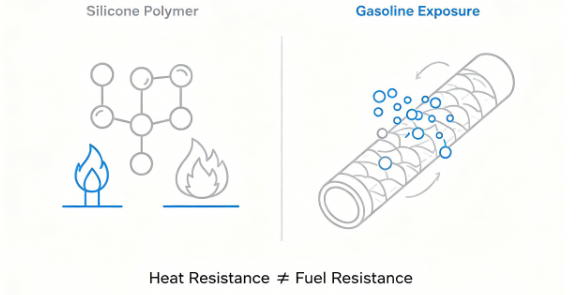
A silicone hose is famous for heat resistance, and this creates one of the most common buyer misunderstandings I see. Heat performance feels like proof of toughness. However, gasoline resistance is a chemical compatibility issue, not just a temperature rating issue.
Silicone can perform well at high temperatures, often far above many general-purpose rubbers, but gasoline can still attack its service performance. Heat resistance, flexibility, and clean appearance do not prove fuel resistance. A hose must be verified for the actual fuel and operating conditions.
Temperature rating and chemical resistance are different tests
A hose can be excellent in one category and unsuitable in another. I see this confusion often when buyers compare product pages. They read that a silicone hose can handle high temperatures, then they assume it can also handle fuels, oils, and solvents.
That logic is risky.
A typical silicone material may offer strong performance in areas like:
- High and low temperature flexibility
- Weathering resistance
- Ozone resistance
- UV resistance
- Electrical insulation
- Low odor
- Soft touch
- Stable compression behavior in many sealing applications
These strengths explain why silicone is used in medical devices, food and beverage equipment, smart home appliances, new energy components, sealing strips, and industrial profiles.
However, gasoline creates a different challenge. Gasoline contains small molecules that can interact with elastomer networks. Depending on the material and fuel blend, those molecules may enter the hose wall and affect the structure. The visible result may be swelling, softening, surface tackiness, or dimensional instability.
What can happen inside the hose?
A buyer may only look for leaks. I look for a broader set of failure modes because leakage is often the last stage, not the first warning.
Common risk signs include:
- Diameter growth after exposure
- Wall softening under finger pressure
- Loss of rebound after bending
- Clamp area deformation
- Fuel smell around the hose
- Surface sweating or tackiness
- Kinking under suction
- Reduced burst or pressure safety margin
These issues matter because hoses work as systems. A gasoline line is not only a tube. It includes clamps, fittings, bends, vibration, pressure changes, and maintenance habits. If the hose swells by even a small amount, the connection can become less stable. If the wall softens, a tight bend can collapse. If permeation increases, the user may smell fuel even without visible dripping.
Why “high temperature” can make the fuel problem worse
Temperature still matters, but not in the way many buyers expect. Heat does not protect silicone from gasoline. In some cases, higher temperature can accelerate chemical interaction, swelling, vapor pressure, and permeation.
For example, a hose near an engine or pump may face:
| Condition | Why it matters |
|---|---|
| Elevated temperature | Can speed up material changes |
| Pump pulsation | Repeated stress can expose weak points |
| Tight bends | Softened hose may kink or flatten |
| Clamped fittings | Swelling can change sealing pressure |
| Fuel vapor | Vapor exposure can still affect materials |
| Outdoor use | UV, ozone, and fuel exposure combine |
This is why I avoid giving a simple yes or no answer. If someone asks, “Will silicone hold up to gasoline?” my practical answer is: ordinary silicone should not be chosen for long-term gasoline service unless the hose construction has been specifically verified for that fuel duty.
That does not mean silicone is a poor material. It means every material has limits. In my own work, I prefer to protect the buyer from a wrong application rather than sell a hose that looks suitable but may fail later.
Does food-grade or medical-grade silicone hose resist gasoline?
A silicone hose labeled food-grade, FDA-compliant, medical-grade, transparent, odorless, or platinum-cured can still be unsuitable for gasoline. I see this misunderstanding often because buyers connect “safe” with “chemically resistant.” These are different requirements.
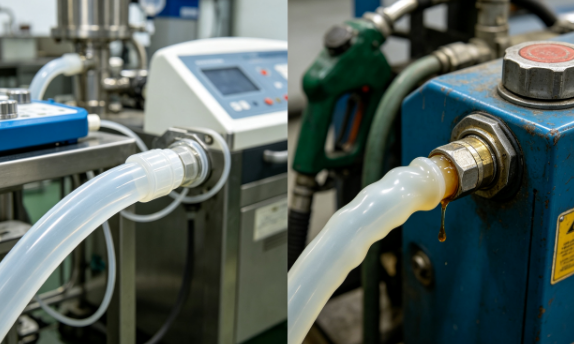
Food-grade or medical-grade silicone hose is designed for cleanliness, biocompatibility, odor control, or contact safety, not automatic gasoline resistance.5 FDA, LFGB, or medical-use claims do not prove fuel compatibility. Gasoline service requires separate chemical-resistance and application verification.
Safety certifications do not replace fuel compatibility
This is one of the most important points in the article. I have handled many inquiries where a buyer says, “This hose is food-grade, so it should be stronger and safer for fuel.” I understand the thinking. Food-grade silicone sounds premium. Medical-grade silicone sounds even better. Clear silicone looks pure and clean.
However, those labels answer different questions.
They may answer:
- Can the material be used in certain food-contact applications?
- Does it meet specific extractable or safety-contact requirements?
- Is it odorless enough for sensitive applications?
- Is the surface smooth and easy to clean?
- Is the formulation controlled for certain regulated uses?
They do not automatically answer:
- Will it resist gasoline swelling?
- Will it prevent fuel vapor permeation?
- Will it keep pressure rating after fuel exposure?
- Will it survive ethanol-blended gasoline?
- Will it hold clamps after long-term contact?
- Will it remain safe near heat and vibration?
A simple comparison
| Claim on hose | What it may indicate | What it does not prove |
|---|---|---|
| Food-grade | Suitable for certain food-contact conditions | Gasoline resistance |
| FDA-related | Meets specific contact-safety rules | Fuel transfer performance |
| Medical-grade | High cleanliness or biocompatibility focus | Automotive fuel-line suitability |
| Platinum-cured | Cleaner curing system and low odor | Fuel compatibility |
| Transparent | Easy visual flow observation | Chemical resistance to gasoline |
| High-temperature | Heat stability | Resistance to fuel swelling |
This distinction matters for industrial buyers. In food and beverage equipment, silicone tubing is often selected because it is clean, flexible, and temperature-resistant. In medical or pharmaceutical equipment, silicone may be chosen for peristaltic pump tubing, diagnostic equipment, or fluid transfer where purity and flexibility matter.
Those are valid uses. Gasoline transfer is a different use.
Why transparent silicone can be especially misleading
Clear silicone tubing often looks professional. It lets users see fluid flow. It is soft, flexible, and easy to install. This makes it attractive for small-engine users, DIY repair, and light equipment projects.
However, a clear appearance does not mean the tube can carry gasoline. In fact, I become more cautious when a buyer wants to use soft transparent silicone for fuel. The hose may install easily, but it may also absorb fuel components, soften, swell, or allow vapor odor through the wall.
I usually ask buyers to avoid choosing by appearance. Instead, I suggest choosing by specification:
Fluid type
Is it gasoline, diesel, ethanol blend, oil, coolant, water, air, or chemical solution?Contact pattern
Is exposure accidental, intermittent, continuous, or immersion?Temperature range
What is the normal and maximum working temperature?Pressure or vacuum
Is the line pressurized, suction-based, gravity-fed, or pulsed by a pump?Mechanical layout
What is the bend radius? Are there clamps, fittings, vibration, or movement?Compliance needs
Does the application require FDA, RoHS, REACH, SAE, ISO, or other standards?
A good supplier should not simply say, “Yes, silicone is high temperature.” A responsible supplier should ask these questions first. That is how I approach custom silicone tubing, molded parts, sealing profiles, and foamed silicone products in our factory consultations.
How should I choose a silicone hose alternative for gasoline?
A silicone hose is usually not my first recommendation for gasoline transfer, especially for continuous or long-term use. The better approach is to define the fuel, conditions, and safety requirements first. Then the buyer can choose a hose built and verified for fuel service.
For gasoline applications, I recommend using a fuel-compatible hose specification rather than a regular silicone hose. The right choice depends on fuel blend, pressure, temperature, permeability needs, installation space, and standards. Always confirm compatibility with the hose supplier or technical datasheet before purchasing.
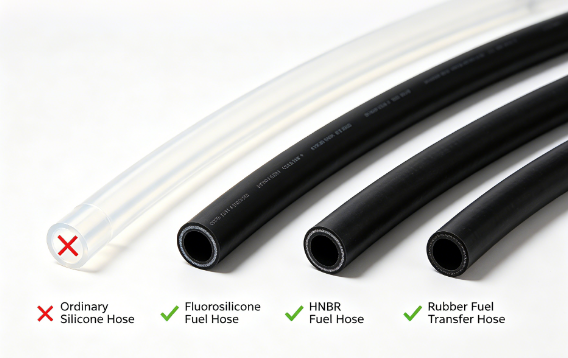
Start with the application, not the material name
When someone asks me for “silicone tubing for gasoline,” I do not start by quoting a price. I start by clarifying the application. That step can prevent expensive failure later.
Here is the checklist I use in consultation:
What fuel will pass through the hose?
Gasoline, E10, E15, racing fuel, diesel, oil, or mixed solvent?How long will the hose contact the fuel?
Seconds, minutes, hours, daily operation, or permanent immersion?What is the working temperature?
Room temperature, engine-bay heat, outdoor summer exposure, or heated process?What is the working pressure?
Gravity flow, suction, low pressure, high pressure, or pump pulsation?What is the hose size?
Inner diameter, outer diameter, wall thickness, and tolerance matter.How will it be installed?
Straight line, tight bend, moving part, clamp connection, or threaded fitting?What failure would cost?
Minor replacement, equipment downtime, safety incident, environmental leakage, or customer complaint?
This approach is slower than saying “yes” or “no,” but it is much safer.
Common hose material direction
I will avoid pretending that one material fits all gasoline applications. Fuel hose selection can involve standards and engineering details beyond a simple blog answer. Still, buyers can use the table below as a practical starting point for discussion with suppliers.
| Hose type or material direction | Common reason buyers consider it | Notes for gasoline use |
|---|---|---|
| Regular silicone hose | Heat resistance, flexibility, clean look | Not recommended for long-term gasoline transfer |
| Fluoropolymer-lined hose6 | Chemical resistance and low permeability needs | Often considered for aggressive fuel environments |
| NBR fuel hose | Common fuel and oil resistance | Must match pressure, fuel blend, and standard |
| FKM-based hose or lining | High chemical and heat resistance | Often used where fuel resistance is critical |
| Reinforced fuel hose | Pressure and mechanical strength | Verify rating and fuel compatibility |
| Certified automotive fuel hose | Designed for fuel systems | Check standard, size, pressure, and fuel blend |
The key is not to memorize every material. The key is to buy by verified service rating.
Do not ignore pressure and clamps
Many small failures happen at the connection point, not in the middle of the hose. If gasoline exposure softens or swells a hose, the clamp area becomes a weak point. A hose that felt tight on day one may loosen after repeated exposure. Vibration makes this worse.
I advise buyers to check:
- Clamp type and material
- Fitting barb design
- Hose inner diameter tolerance
- Wall thickness
- Minimum bend radius
- Reinforcement layer
- Pressure and vacuum rating
- Temperature rating after fuel exposure
A regular silicone hose may have excellent flexibility, but flexibility alone does not guarantee sealing security under fuel contact.
What I can responsibly say as a silicone supplier
I can say this from practical supplier experience: many buyers overestimate silicone because they associate it with premium performance. Silicone is indeed a premium material in the right application. Our factory produces silicone tubes, seal strips, molded parts, foamed silicone products, and custom profiles for industries such as medical devices, food equipment, automotive parts, new energy, smart home, and industrial systems.
However, I do not want to overclaim. I should not tell a customer that ordinary silicone tubing is suitable for long-term gasoline transfer unless the hose construction has been specifically designed and verified for that duty.
A responsible answer is:
Regular silicone hose is not recommended for long-term gasoline transfer. Please confirm the exact fuel, contact time, temperature, pressure, and installation conditions, then choose a fuel-compatible hose specification.
That answer may sound cautious. I think caution is appropriate when fuel leakage can create safety and downtime problems.
What questions should I ask before using a silicone hose near gasoline?
A silicone hose may still appear in equipment located near fuel, even if it does not directly transfer gasoline. The problem is that buyers sometimes skip the boundary between nearby exposure and direct contact. That missing detail can lead to wrong material selection.
Before using silicone near gasoline, I would ask whether the hose will see splash, vapor, direct flow, pressure, heat, or immersion. I would also confirm cleaning chemicals, installation stress, and expected service life. These details decide whether silicone is acceptable or a fuel-rated alternative is required.
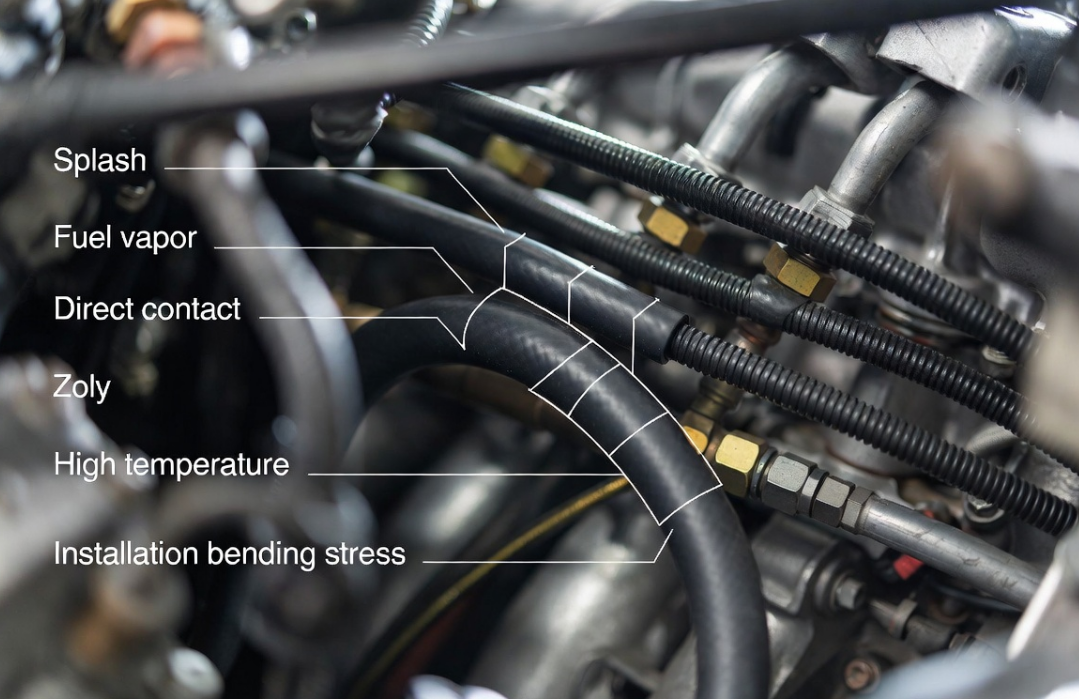
The consultation questions I ask first
When I receive a hose inquiry, I try to make the buyer’s real working condition visible. I do not assume the product name tells the full story. A “fuel-related” application could mean many things.
I usually ask these questions:
- Will gasoline flow inside the hose?
- Will the hose only be near gasoline vapor?
- Will fuel splash onto the outside surface?
- How often will exposure happen?
- How long should the hose last?
- Will the hose run near an engine or heat source?
- Will a pump create pulsation?
- Will the hose be under suction or pressure?
- Will the line bend sharply?
- Will the equipment operate outdoors?
- Are there safety standards or customer specifications?
These questions may feel basic, but they prevent most misunderstandings.
Accidental exposure versus continuous duty
I like to use a simple phrase with customers: “Exposure is not the same as application.”
A silicone part may survive a fuel splash. That does not make it a fuel hose. A seal may sit near a fuel area. That does not make it suitable for fuel immersion. A tube may pass a short trial. That does not prove it will survive months of gasoline service.
This distinction helps buyers avoid three common mistakes:
Testing for too short a time
A one-hour or one-day exposure cannot represent long-term use.Testing without heat or pressure
Room-temperature soaking is not the same as engine-bay operation.Ignoring dimensional change
No visible leak does not mean no swelling, softening, or permeation.
When silicone may still be suitable nearby
Silicone may still be a good material in fuel-adjacent equipment if it does not act as the gasoline transfer path. For example, silicone seal strips, insulation sleeves, grommets, or protective profiles may be useful where heat, weathering, or flexibility matter. However, I would still check whether fuel splash or vapor exposure is expected.
For industrial equipment, construction machinery, small engines, or repair projects, I would separate components into two groups:
| Component role | Silicone may be considered? | Comment |
|---|---|---|
| Air duct near engine heat | Yes, often | Confirm temperature and environment |
| Coolant hose | Sometimes | Depends on coolant and pressure |
| Dust or weather seal | Often | Check splash exposure |
| Electrical insulation sleeve | Often | Check chemical contact |
| Gasoline transfer line | Usually no | Use verified fuel hose |
| Fuel immersion tube | No for regular silicone | Use fuel-immersion-rated material |
This practical sorting saves time. It also keeps silicone in the applications where it performs well, instead of forcing it into a service condition that may cause failure.
Frequently Asked Questions
Can I use silicone vacuum hose as a gasoline fuel line?
I would not use regular silicone vacuum hose as a gasoline fuel line. Vacuum hose is usually selected for air or vacuum service, not fuel compatibility. Gasoline may cause swelling, softening, permeation, or leakage. Use a hose verified for gasoline and the required pressure or suction conditions.
Is platinum-cured silicone hose better for gasoline?
Platinum-cured silicone hose may offer cleaner curing, lower odor, and better suitability for certain food, medical, or high-purity applications. However, platinum curing does not automatically make silicone gasoline-resistant. Fuel compatibility still requires separate verification for the exact gasoline blend, temperature, contact time, and pressure.
What happens if gasoline sits inside a silicone hose overnight?
Gasoline sitting inside a regular silicone hose overnight may not always cause visible failure, but it can start swelling, softening, or permeation depending on the hose and fuel. I would not treat overnight survival as approval for service. Inspect the hose and switch to verified fuel-compatible tubing.
Are silicone hoses safe for diesel fuel?
Diesel and gasoline are different fluids, but I would still avoid assuming regular silicone hose is suitable. Diesel compatibility depends on formulation, exposure time, temperature, pressure, and hose construction. Always check the supplier’s chemical resistance data and choose hose rated for the actual fuel.
Why do some sellers say silicone hose works with fuel?
Some sellers may refer to brief contact, special lined constructions, or general heat-resistant use, while buyers may interpret that as long-term gasoline compatibility. I recommend asking for written specifications, test conditions, fuel type, pressure rating, temperature range, and service limitations before using any hose for fuel transfer.
Conclusion
A silicone hose should not be selected as a long-term gasoline transfer hose just because it is flexible, clean, food-grade, or heat-resistant. The better question is whether the exact hose has been verified for the fuel blend, contact time, temperature, pressure, bend radius, and service conditions. If you need custom silicone tubing, seals, or profiles for the right application, contact us with your working conditions. I will help you review the material choice before production.
"Silicone hose for fuel injection : r/WRX - Reddit", https://www.reddit.com/r/WRX/comments/1lf4wvf/silicone_hose_for_fuel_injection/. Engineering compatibility references generally classify standard silicone rubber as unsuitable or not recommended for continuous gasoline service, distinguishing heat resistance from fuel compatibility. Evidence role: expert_consensus; source type: institution. Supports: An engineering or standards-oriented source should support that standard silicone rubber is generally not recommended for continuous gasoline service.. Scope note: The support is general because specialized silicone constructions or lined hoses may differ from ordinary silicone hose. ↩
"Automotive fuel hose – how much do you know? - Autoworks", https://autoworks.com.au/blog/items/automotive-fuel-hose-how-much-do-you-know. Hose-selection standards and elastomer compatibility guidance treat fluid composition, exposure duration, temperature, pressure, and installation conditions as variables that affect suitability for fuel service. Evidence role: general_support; source type: institution. Supports: A standards or engineering source should support that hose compatibility and performance depend on fluid composition and service conditions such as temperature, pressure, and exposure time.. Scope note: Such sources support the selection principle rather than testing the specific hose discussed in the article. ↩
"Fuel Oxygenates and USTs | US EPA", https://www.epa.gov/ust/fuel-oxygenates-and-usts. Government fuel references describe gasoline as a complex petroleum-derived mixture containing numerous hydrocarbons and additives, including oxygenates such as ethanol in many commercial blends. Evidence role: definition; source type: government. Supports: A government or encyclopedia source should support that gasoline is a complex mixture of hydrocarbons and additives, often including oxygenates such as ethanol.. ↩
"Gasoline Properties Over Time | US EPA", https://www.epa.gov/fuels-registration-reporting-and-compliance-help/gasoline-properties-over-time. Fuel-quality and regulatory sources describe commercial gasoline as containing hydrocarbon classes, regulated additives, detergents, and oxygenates such as ethanol, with formulations varying by market and regulation. Evidence role: definition; source type: government. Supports: A fuel regulatory or government source should support the composition and additive variability of commercial gasoline, including ethanol blends.. Scope note: The source may document common or regulated components rather than every regional additive package. ↩
"Chemistry Recommendations for Submissions of Food Contact ...", https://www.fda.gov/regulatory-information/search-fda-guidance-documents/guidance-industry-preparation-premarket-submissions-food-contact-substances-chemistry. Food-contact and medical biocompatibility frameworks evaluate safety-related endpoints such as extractables, toxicological risk, or biological response; they do not by themselves establish compatibility with gasoline service. Evidence role: definition; source type: government. Supports: A regulatory source should support that food-contact or medical biocompatibility designations concern safety or biological evaluation rather than fuel resistance.. Scope note: The source supports the regulatory distinction and does not necessarily discuss silicone fuel hoses directly. ↩
"Fuel hose / tube | Fluorochemicals | Daikin Global", https://www.daikinchemicals.com/solutions/industries/automotive/fuel-hose-tube.html. Materials references on fluoropolymers report high resistance to many fuels and solvents and relatively low permeability, explaining their use as liners in chemically demanding hose applications. Evidence role: general_support; source type: research. Supports: A materials research or engineering source should support that fluoropolymers such as PTFE or FEP are used for chemical resistance and relatively low fuel permeation.. Scope note: The source may support fluoropolymer properties generally; actual hose suitability still depends on construction, fittings, and rated service conditions. ↩

发表回复