-Choosing the wrong hose looks small until it swells, cracks, leaks, or stops a line. I see buyers lose time when material is guessed.
A silicone hose is not always better than a rubber hose. I usually choose silicone when hygiene, clean contact, wide temperature range, flexibility, aging resistance, and custom size stability matter. I still confirm the medium, pressure or vacuum, size, hardness, and installation before I suggest it.
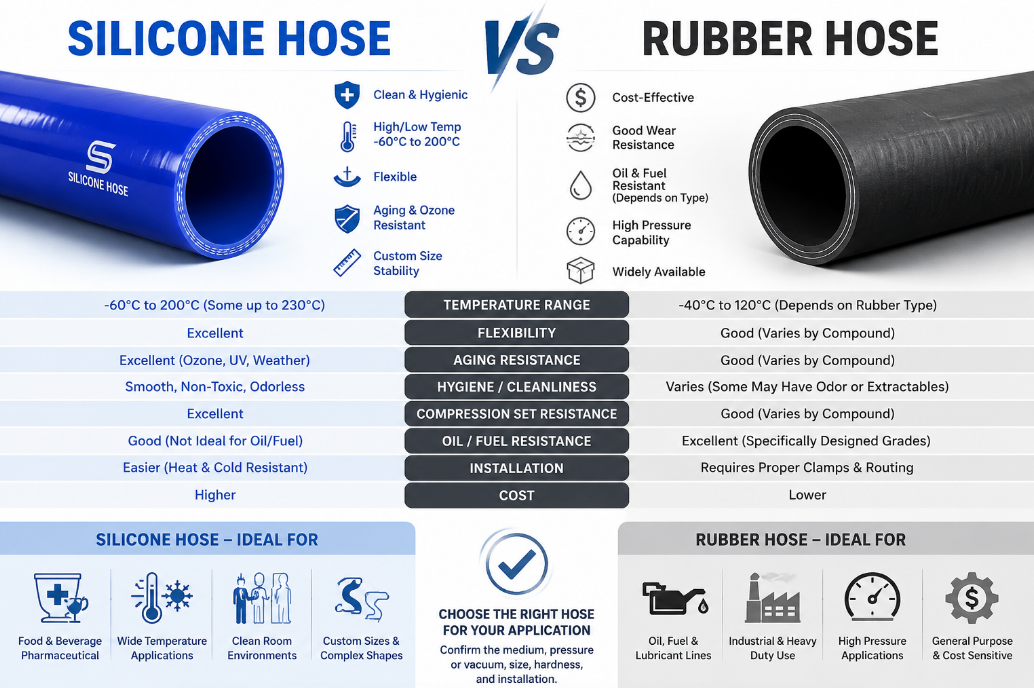
I hear this question often from industrial buyers, food equipment teams, and transport-related procurement people. I do not answer it with a simple yes. I first ask what the hose carries, where it works, and how it is installed. A hose is not better because its material sounds better. A hose is better when it is safer for the real working condition.
What should I check before comparing silicone hose and rubber hose?
A wrong first question can lead to a wrong hose. I see this when buyers compare material names before they check the medium.
I first check the medium, temperature, pressure or vacuum, bending condition, size, hardness, and connection method. These points tell me whether silicone hose, rubber hose, or another structure is safer for the application.
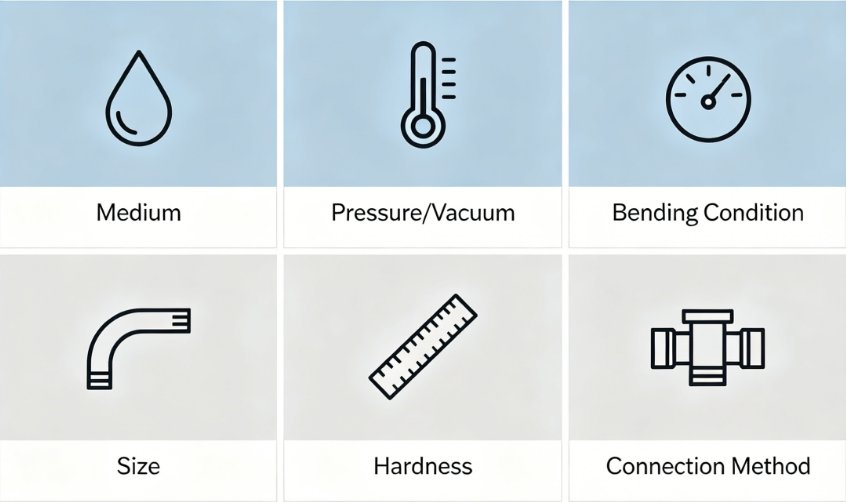
I usually tell buyers that the first variable is the medium. The hose may carry air, water, food liquid, steam, oil, coolant, solvent, acid, alkali, or mixed chemical fluid. Each medium can change the answer. I also ask about the working temperature and the cleaning temperature, because a hose may survive normal use but fail during hot cleaning. I ask about pressure and vacuum because a soft hose can expand under pressure or collapse under suction. I ask about bending because a hose that looks good on a table may kink inside a machine.
I use a simple check list during early communication.
| Item I check | Why I check it | Common risk if ignored |
|---|---|---|
| Medium | Material compatibility depends on contact liquid or gas | Swelling, hardening, odor, or leakage |
| Temperature | Heat and cold change flexibility and aging | Cracking, softening, or shorter life |
| Pressure or vacuum | Hose wall and reinforcement must match load | Bursting, expansion, or collapse |
| Inner diameter and wall thickness | Flow and fitting need correct size | Poor fit, low flow, or leakage |
| Hardness | Softness affects sealing and bending | Loose connection or hard installation |
| Connection method | Clamp, barb, coupling, or groove changes design | Hose slips off or cuts at the joint |
I do not treat this as paperwork. I treat it as risk control. When a buyer sends a drawing, a sample, or simple parameters, I can discuss the case with factory, QC, or technical colleagues. I do not claim that I personally run every lab test. I use the information that the team can confirm, and I keep the suggestion within the known working condition.
Does silicone hose resist oil, solvents, acids, and chemicals?
A common mistake can create a costly failure. Some buyers think silicone resists every chemical because it is clean and heat resistant.
Silicone hose does not resist every oil, solvent, acid, alkali, or chemical. I always confirm the exact medium, temperature, exposure time, concentration, and hose structure before I suggest silicone for chemical contact.
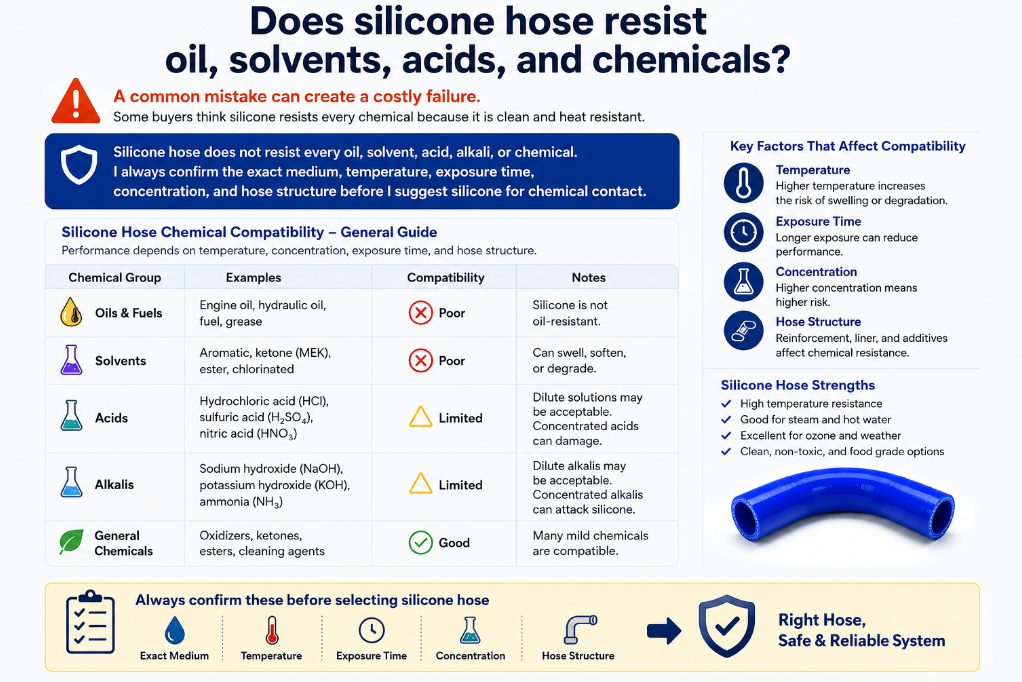
I see this point in many inquiries. A buyer may say, “It is just liquid.” I still ask what liquid it is. Water is different from edible oil. Edible oil is different from fuel oil. Mild cleaning liquid is different from strong solvent. Acid and alkali also change by concentration and temperature. A short contact during cleaning is not the same as full-time immersion. A cold liquid is not the same as a hot liquid under pressure.
Silicone often performs well in clean contact applications, high and low temperature conditions, and aging resistance.1 It can also be low odor and flexible. This does not mean it is universal. Some rubber types can perform better for oil, fuel, abrasion, or heavy mechanical use. NBR, EPDM, neoprene, and other rubber materials each have their own purpose.2 I do not place all rubber into one low-end category.
| Medium or condition | My usual caution | Possible direction |
|---|---|---|
| Water or air | I check temperature and pressure | Silicone may be suitable |
| Food liquid | I check food contact needs and cleaning | Food-grade silicone is often considered |
| Oil or fuel | I do not assume silicone is suitable | Some rubber types may be better |
| Solvent | I ask for exact solvent name | Compatibility must be confirmed |
| Acid or alkali | I ask for concentration and temperature | Material choice depends on details |
| Abrasive flow | I check wear risk | Rubber or special structure may be needed |
I prefer careful words here because broad claims create real problems. If the hose fails, the buyer does not care that the catalog looked attractive. The buyer cares that the line is down. I care about avoiding that mistake before sampling.
When is silicone hose the better choice for procurement?
A buyer can overpay or under-spec a hose when the selection is only price based. I see this most in clean or high-temperature equipment.
I usually prefer silicone hose when the buyer needs hygiene, low odor, flexible handling, high or low temperature performance, aging resistance, color choice, and stable custom dimensions.

I often suggest silicone hose for food and beverage equipment, water systems, medical-related non-implant parts, smart home devices, clean fluid transfer, sealing sleeves, and some industrial air or water lines. I say “often” because each case still needs confirmation. Silicone can be a good choice when the hose must stay flexible, when the surface needs to be clean, or when the buyer wants transparent or colored tubing with stable dimensions.
In export sales communication, I also see procurement reasons behind the material choice. The buyer may need consistent inner diameter, wall thickness, hardness, color, cut length, packaging, and batch stability. These points matter when the hose is installed into the same machine again and again. A good material is not enough if the size changes too much.
| Procurement need | Why silicone can help | What I still confirm |
|---|---|---|
| Clean contact | Silicone can be low odor and clean | Required standard and actual use |
| Temperature range | Silicone often handles heat and cold well | Working and peak temperature |
| Flexibility | Silicone can bend well in small spaces | Bending radius and kink risk |
| Custom color | Silicone can be made in many colors | Color tolerance and MOQ |
| Stable size | Extrusion control can support repeat orders | ID, OD, wall, and tolerance |
| Soft sealing | Silicone can compress and seal well | Hardness and clamp pressure |
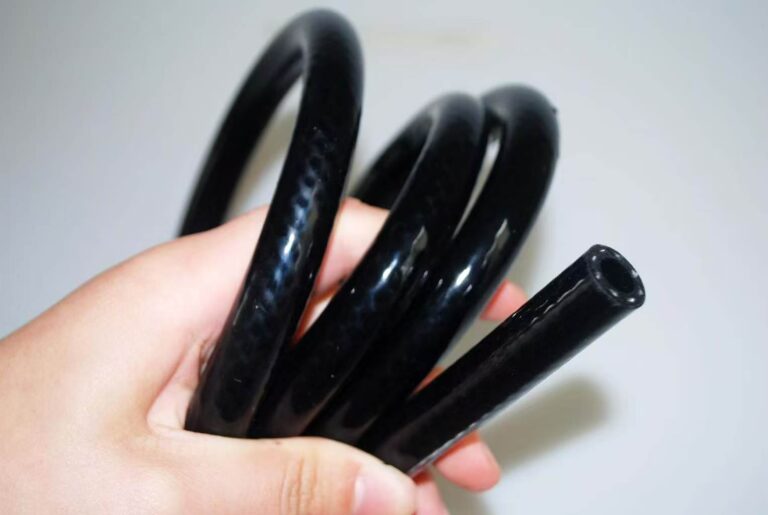
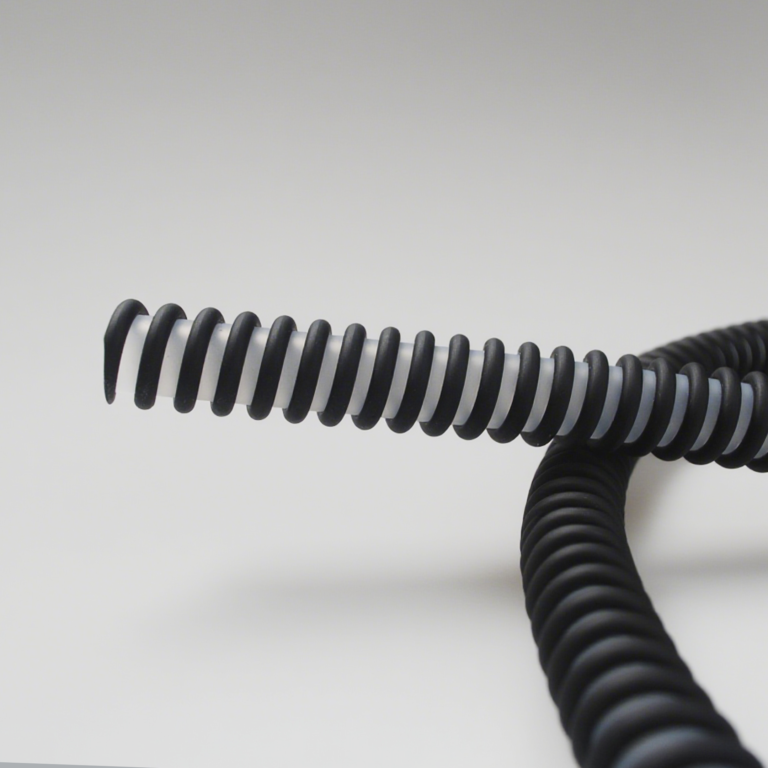
I also pay attention to structure. A plain silicone tube is not the same as a braided silicone hose. A foamed silicone tube is not the same as a solid tube. A coiled tube, multi-lumen tube, open tube, or corrugated tube solves different problems. When a buyer says “silicone hose,” I ask which structure they need. I learned this from repeated sample checks. Two hoses may look similar in a photo, but they may work very differently in a machine.
When can rubber hose be the better choice?
A buyer can make the opposite mistake too. Silicone is not always the smarter choice, even when it looks cleaner and more flexible.
Rubber hose can be better when the application needs oil resistance, abrasion resistance, high pressure performance, special mechanical strength, or lower cost. The exact rubber type must still match the medium.

I do not describe rubber as one simple material. Rubber hoses can be made from different materials and structures. Some rubber hoses are made for fuel, oil, hydraulic pressure, outdoor weather, abrasion, or rough installation. A silicone hose may not be the best answer in those cases. A buyer may also choose rubber when the application is cost-driven and the working condition is simple. I respect that choice when the risk is controlled.
The real comparison is not “silicone versus rubber” in a general way. The real comparison is “this silicone structure versus this rubber structure under this working condition.” I use that sentence often because it keeps the discussion practical. A thick hose may handle mechanical stress better than a thin hose. A reinforced hose may handle pressure better than a plain hose. A correct rubber compound may resist oil better than a general silicone tube.
| Situation | Why rubber may be better | My practical question |
|---|---|---|
| Oil or fuel contact | Some rubber types are designed for it | What oil or fuel is used? |
| Abrasion | Some rubber hoses resist wear better | Does the hose rub against parts? |
| High pressure | Reinforced rubber hoses are common | What is working and burst pressure? |
| Outdoor rough use | Some rubber materials fit harsh use | Is ozone, UV, or weather3 involved? |
| Tight budget | Rubber can be more cost friendly | What failure risk is acceptable? |
| Heavy machinery | Rubber may handle impact better | Is there vibration or movement? |
I find that the best procurement decision is not emotional. It is technical and commercial at the same time. I compare risk, cost, delivery, replacement cycle, and installation. I also remind buyers that a low unit price may become expensive if the hose cracks, leaks, or needs frequent replacement. I do not use this point to push silicone. I use it to help the buyer calculate the real cost of failure.
How do I confirm size, pressure, and structure before ordering?
A hose can fail even when the material is correct. I see this when the size, wall thickness, or reinforcement is not matched to the installation.
I confirm inner diameter, outer diameter, wall thickness, length, hardness, tolerance, pressure or vacuum, bending route, and fitting type before sampling or mass production.
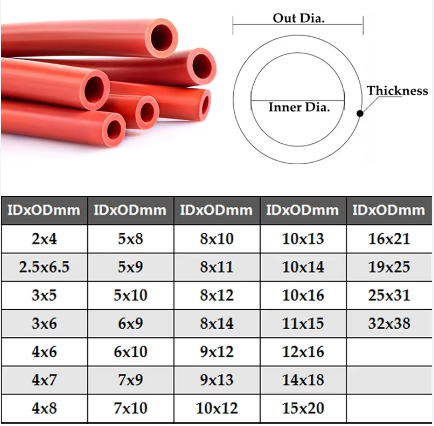
I ask for drawings when the hose must fit a fixed machine. I ask for a sample when the buyer cannot describe the profile clearly. I ask for photos when the installation space is hard to explain. I ask for the fitting type because a barb fitting, clamp fitting, metal connector, or plastic connector changes the sealing behavior. A tube that is too hard may not seal well. A tube that is too soft may deform under clamp force. A tube with a thin wall may kink or collapse under vacuum. A tube without reinforcement may not be suitable for pressure.
I also separate pressure and vacuum in the discussion. Some buyers only mention pressure, but the hose actually works under suction. This matters because a hose can collapse inward under vacuum. In that case, I may discuss thicker walls, higher hardness, braided reinforcement, spiral support, or another design with technical colleagues.
| Dimension or structure | What I ask | Why it matters |
|---|---|---|
| Inner diameter | What flow and fitting size are needed? | It controls flow and connection |
| Outer diameter | Is there limited space? | It affects assembly and clamps |
| Wall thickness | Is pressure or vacuum present? | It affects strength and flexibility |
| Hardness | Is the hose used for sealing or transfer? | It affects compression and bending |
| Length | Is the hose cut or supplied in coils? | It affects packing and installation |
| Reinforcement | Is pressure, vacuum, or movement involved? | It affects safety and service stability |
| Tolerance | Is the machine assembly sensitive? | It affects repeat production and fit |
I prefer to confirm these details before quoting a final solution. A fast quote can be useful, but a fast wrong quote wastes more time later. In our daily export work, I may start with a general price range, then refine it after the buyer sends more data. This is normal for custom silicone tubes, silicone sleeves, molded silicone parts, foamed silicone strips, and special profiles. A clear parameter sheet makes the sample stage smoother.
How should I decide between silicone hose and rubber hose in real purchasing?
A buyer can feel stuck when both materials seem possible. I see this when the application has several working conditions at the same time.
I decide by matching the hose material and structure to the medium, temperature, pressure or vacuum, movement, hygiene need, fitting method, target cost, and replacement risk.
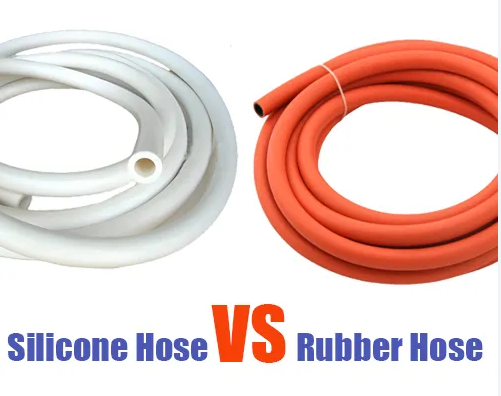
I use a simple decision path in real communication. I start with safety, then I move to performance, then I move to cost. I do not start with the cheapest material. I also do not start with the most expensive material. I start with the material that can reduce the main failure risk. If the line carries food liquid, I focus on clean contact and certification needs. If the hose carries oil, I focus on oil compatibility. If the hose works near heat, I focus on temperature resistance. If the hose bends every day, I focus on flexibility and fatigue. If the hose works under suction, I focus on collapse risk.
| Main concern | I usually focus on | Silicone may be chosen when | |---|---|---|| Hygiene | Clean material and low odor | Food contact and easy cleaning matter | | Temperature | Heat and cold behavior | Wide temperature use matters | | Aging | Long-term flexibility | Cracking and hardening are key risks | | Oil contact | Compatibility with oil | Silicone is only used after confirmation | | Pressure | Wall and reinforcement | Reinforced structure is confirmed | | Cost | Total use cost | Failure risk justifies the choice |
I also ask the buyer about the expected replacement cycle. Some buyers want the lowest initial cost. Some buyers want fewer shutdowns. These two goals may lead to different choices. I try to make this clear early. If a hose is used in a simple low-risk air line, the buyer may not need a high-end solution. If a hose is used in a food system, heating system, medical device support part, or export machine, the buyer may care more about consistency, cleanliness, and stable supply.
I believe the best decision is made with samples and real operating data. A sample can show fit, bending, color, hardness, and assembly feel. A trial run can show whether the hose leaks, kinks, swells, or becomes loose. I can help prepare samples based on drawings, sizes, hardness, and working conditions, but I still tell buyers to test the hose in their own equipment before larger orders.
Conclusion
I do not ask if silicone is better. I ask if silicone is safer for the medium, temperature, pressure, size, hardness, and structure.
"Silicone rubber - Wikipedia", https://en.wikipedia.org/wiki/Silicone_rubber. Silicone elastomers typically maintain flexibility across a temperature range of approximately -60°C to 200°C and exhibit superior oxidative aging resistance compared to many organic rubbers due to the stability of the siloxane backbone. Evidence role: mechanism; source type: research. Supports: the temperature range and aging resistance characteristics of silicone elastomers. Scope note: Performance varies by specific silicone formulation and compounding additives ↩
"(PDF) Elastomer Engineering Guide - Academia.edu", https://www.academia.edu/29713442/Elastomer_Engineering_Guide. NBR (nitrile rubber) provides oil and fuel resistance, EPDM offers weather and ozone resistance with water compatibility, and neoprene (polychloroprene) balances moderate oil resistance with weather durability, making material selection application-dependent. Evidence role: general_support; source type: education. Supports: the distinct chemical resistance profiles of common elastomer types. Scope note: Specific performance depends on polymer grade, compounding, and exposure conditions ↩
"Photodegradation and photostabilization of polymers ... - PMC", https://pmc.ncbi.nlm.nih.gov/articles/PMC4320144/. Ozone attacks unsaturated carbon-carbon double bonds in elastomers causing surface cracking, UV radiation initiates photo-oxidative degradation through free radical formation, and combined weather exposure (temperature cycling, moisture, oxygen) accelerates polymer chain scission and crosslink changes, with degradation rates varying significantly by polymer type. Evidence role: mechanism; source type: research. Supports: environmental degradation mechanisms affecting elastomeric hoses. Scope note: Degradation severity depends on polymer saturation, antioxidant/antiozonant additives, and specific environmental conditions ↩
发表回复