
I often hear this question from buyers. It sounds simple. It can lead to wrong choices when I look only at heat resistance.
Car manufacturers do use silicone hoses in some places. I judge silicone by the medium, temperature, pressure, hose structure, service life, and validation needs. I do not see silicone as a universal replacement for EPDM, NBR, fluororubber, or other rubber materials.
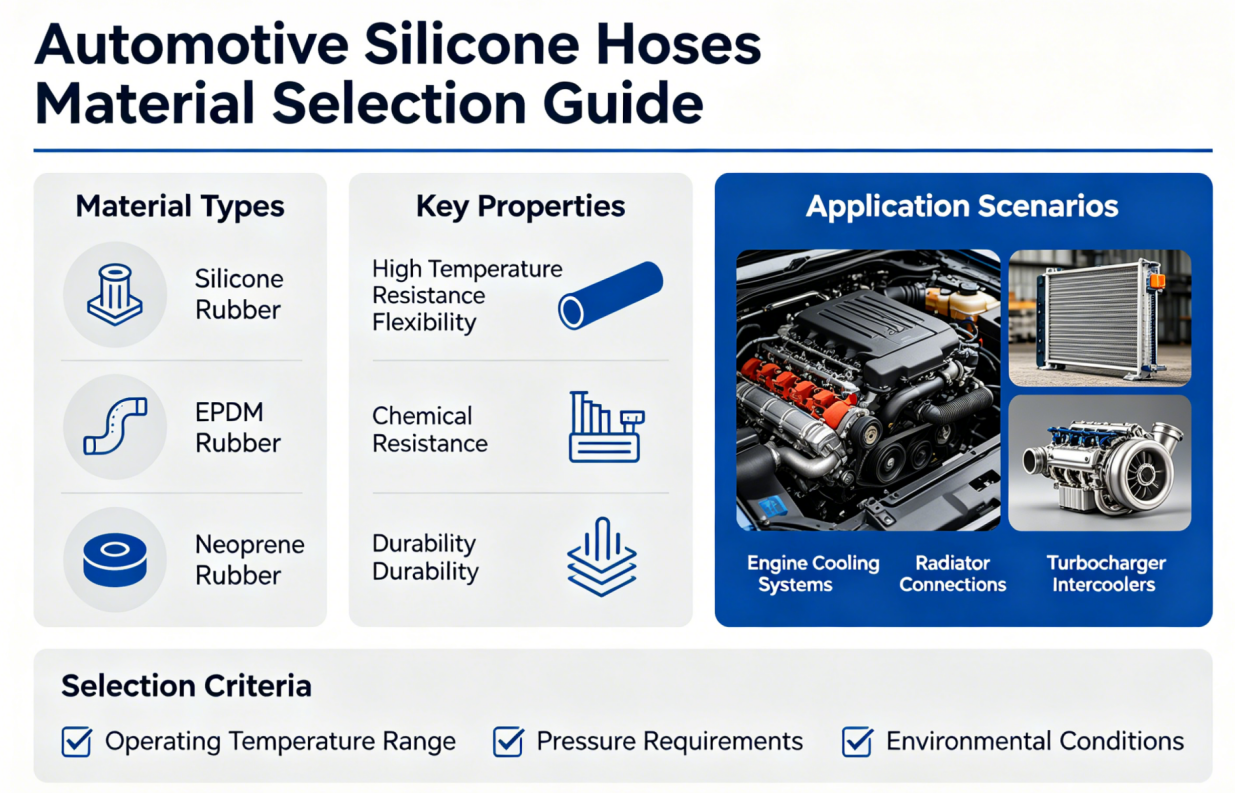
When I discuss automotive silicone hoses with overseas buyers, I first slow the question down. I do not ask, “Is silicone good for cars?” I ask, “What will this hose touch, how hot will it get, how much pressure will it face, and how long must it survive?” This simple change saves many projects from using the right material in the wrong place.
Are Silicone Hoses Actually Unsuitable For Cars?
I see many buyers worry after they hear that OEM cars may not use silicone everywhere. This worry grows when online sellers call silicone “better.”
Silicone hoses are suitable for some automotive systems, but they are not suitable for every automotive fluid line. I check the contacted medium, heat level, pressure pulse, reinforcement, tolerance, and validation before I say silicone is a good choice.
I do not judge silicone by heat only
In my factory work, I have produced and discussed silicone tubes, molded silicone parts, seal strips, and custom profiles for many industrial fields. Automotive and new-energy customers often ask about heat, color, hardness, and shape. I always explain that heat resistance is only one part of the answer. A hose can handle high temperature and still fail because the medium attacks it. A hose can resist the medium and still fail because the pressure pulse is too strong. A hose can pass a sample test and still fail later because the system-level validation is much stricter.
| Question I ask | Why I ask it | What it changes |
|---|---|---|
| What fluid or gas touches the hose? | I need to know chemical contact. | I can judge if silicone is safe or risky. |
| What is the working temperature? | I need the normal heat level. | I can choose material grade and structure. |
| What is the peak temperature? | I need the short-term limit. | I can judge safety margin. |
| What pressure and pulse exist? | I need mechanical load data. | I can decide if reinforcement is needed. |
| What validation is required? | I need the buyer’s standard. | I can avoid giving a shallow answer. |
I see silicone as one tool, not the whole toolbox
I do not say silicone is always better than EPDM, NBR, or fluororubber. Each material has a reason to exist. Silicone has strong points in heat resistance, flexibility, aging resistance, and color customization. It also has limits in oil, fuel, and some high-pressure conditions. I treat it as a material choice, not as a slogan.
Which Automotive Hose Applications Are Silicone Actually Suitable For?
I see confusion when buyers compare aftermarket silicone hoses with OEM parts. The shape may look similar, but the use case may be different.
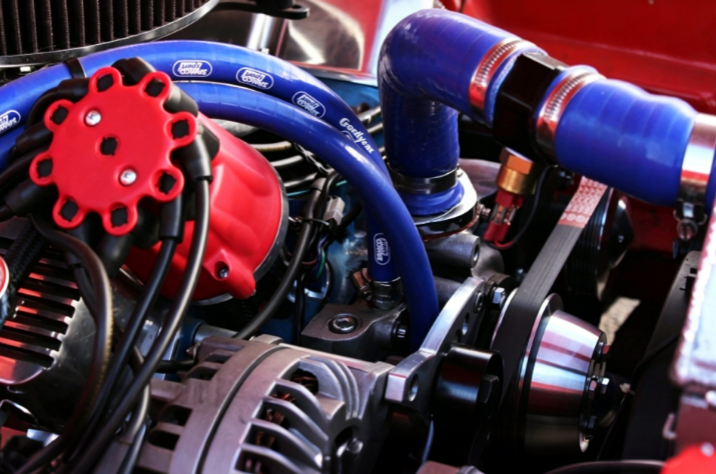
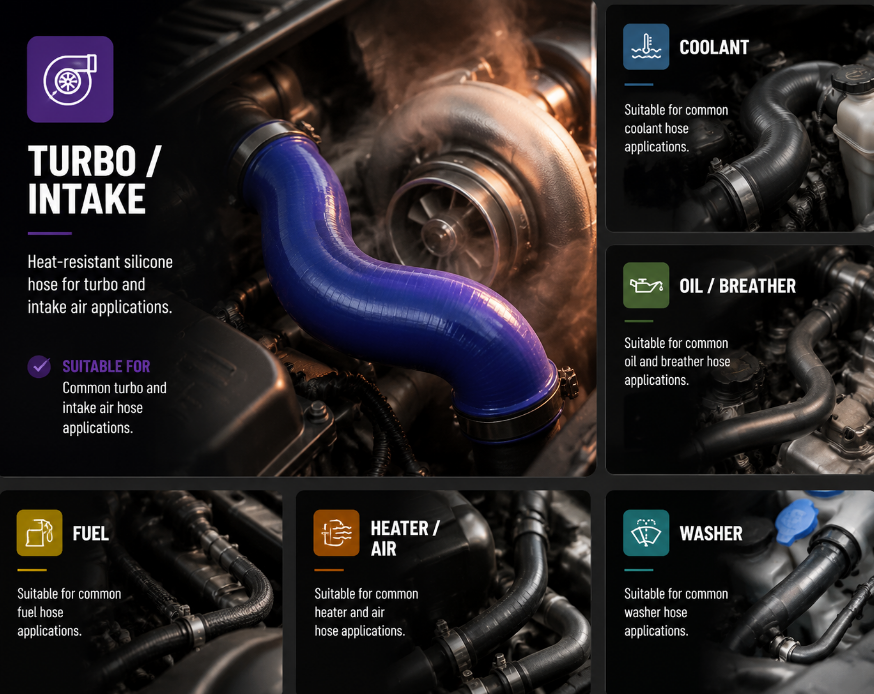
Silicone hoses are often considered for coolant hoses, radiator connection hoses, turbo or intake-related heat-resistant hoses, selected thermal-management parts, insulation parts, and custom aftermarket hoses. Each use still needs checks for medium, pressure, structure, and life.
I look first at coolant and heat-related areas
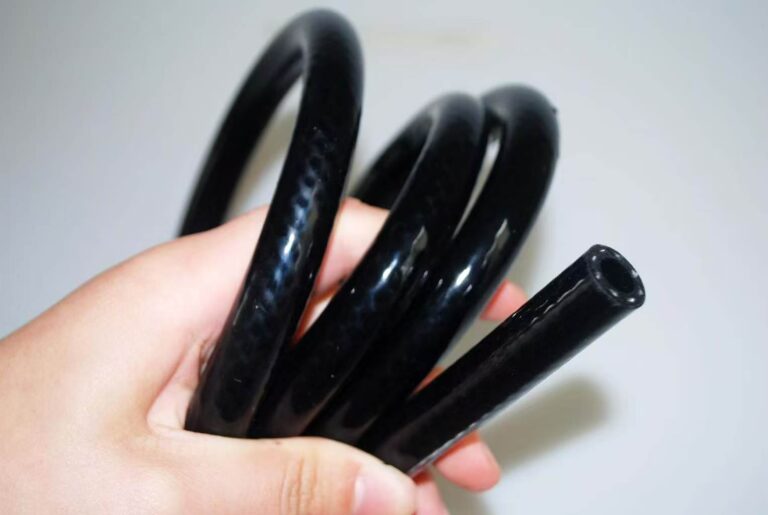
In many automotive discussions, silicone appears most often around coolant and heat-related connections. I see buyers ask for radiator hoses, coolant hoses, intercooler hoses, turbo-related hoses, and shaped connectors. These products may need stable flexibility at high temperature. They may also need fabric reinforcement to hold pressure. In these cases, silicone can be a useful option if the coolant type, pressure, and temperature are clear.
I also see new-energy customers ask about silicone for sealing, insulation, and thermal-management auxiliary parts. These parts may not always be “hoses” in the narrow sense. Some are molded rings, sleeves, foam strips, or custom extruded profiles. I handle these requests by checking hardness, compression set, fire behavior, aging resistance, and dimensional tolerance.
| Application I discuss | Why silicone may fit | What I still need to confirm |
|---|---|---|
| Coolant hose | I value heat resistance and flexibility. | I confirm coolant type, pressure, and service life. |
| Radiator connection hose | I value molded or shaped hose design. | I confirm size, bend, wall thickness, and tolerance. |
| Turbo or intake hose | I value short-term heat resistance. | I confirm oil mist level and pressure pulse. |
| New-energy sealing part | I value aging resistance and insulation. | I confirm compression, flame needs, and testing. |
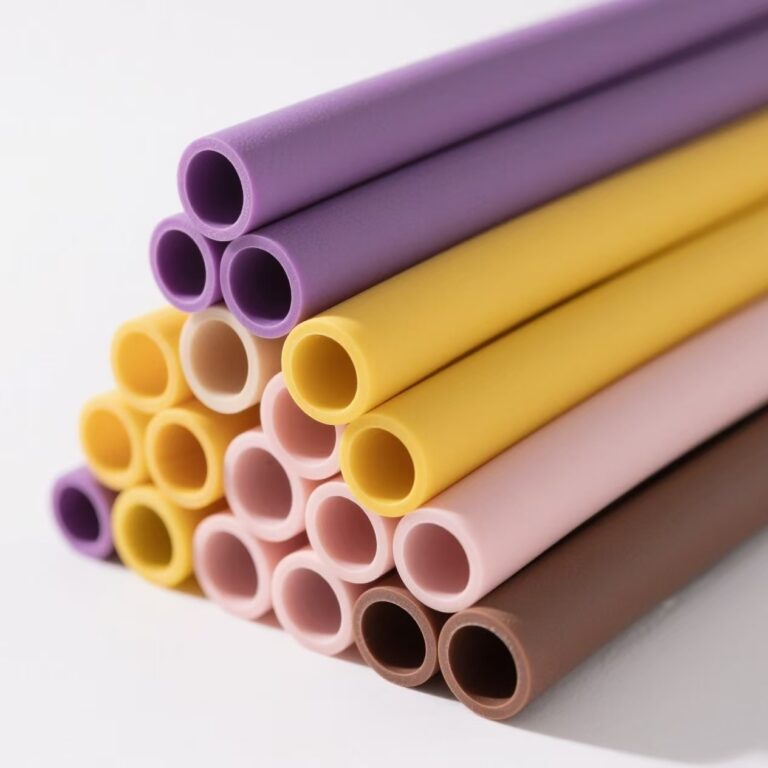
| Aftermarket colored hose | I value color and custom structure. | I confirm real use, not only appearance. |
I separate aftermarket use from OEM mass production
I often see colored silicone hoses in the aftermarket market. They look clean and strong. They can work well in the right system. Still, I do not treat aftermarket use as proof that the same hose is ready for OEM mass production. OEM parts may need long-term system tests, strict batch control, stable supplier approval, and full validation.1 I can support material selection and sample production from a manufacturing side, but I do not pretend to know every internal automaker decision.
This difference matters. A buyer may need ten custom hoses for a modified car. Another buyer may need 100,000 parts for a vehicle platform. These two projects may use different standards, documents, and risk controls.
Where Can Silicone Hoses Create Risk In Automotive Systems?
I get concerned when a buyer says, “The hose is close to oil, but it should be fine because silicone handles heat.” Heat does not solve chemical mismatch.
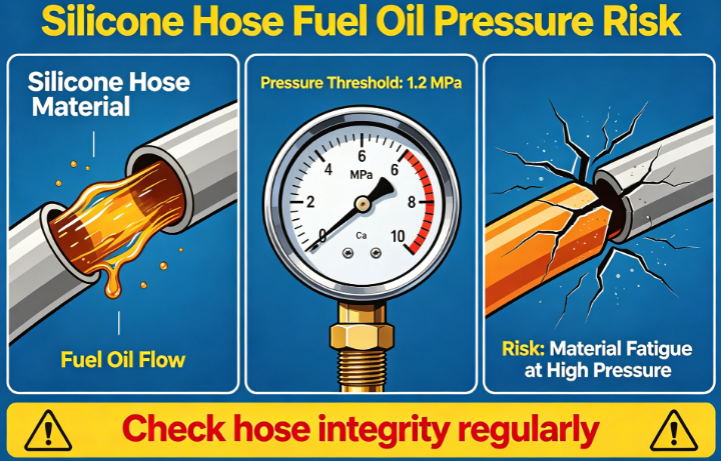
Silicone hoses can be risky for fuel, engine oil, long-term oil mist, strong chemical contact, high-pressure lines, and strong pulse systems.2 I avoid approval based on temperature alone because chemical swelling, softening, leakage, or mechanical failure may occur.
I pay close attention to oil and fuel
From a material point of view, standard silicone is not my first choice for fuel lines or engine oil lines. Some special structures or liner designs may reduce risk, but I still need exact data and testing. Fuel and oil can cause swelling or property loss in unsuitable silicone compounds.3 A hose may look fine during a short sample check. It may still change after long contact, heat aging, vibration, and pressure cycling.
Oil mist is also important. Some intake or turbo-related areas may expose the hose to oil vapor or oil mist.4 A buyer may call the hose an “air hose,” but the real system may not be dry air. I ask about crankcase ventilation, turbo conditions, and possible oil exposure. I do this because the name of the hose is not enough.
| Risk area I check | Main concern I see | My practical response |
|---|---|---|
| Fuel line | I worry about swelling and leakage. | I do not suggest standard silicone without proof. |
| Engine oil line | I worry about long-term material attack. | I ask for media test and standard requirements. |
| Oil mist exposure | I worry about slow property change. | I ask if a liner or other material is needed. |
| High-pressure line | I worry about burst and pulse fatigue. | I check reinforcement and test data. |
| Strong pulse system | I worry about repeated stress. | I ask for pressure cycle validation. |
I do not replace validation with confidence
I can make silicone hoses by extrusion, molding, reinforcement, cutting, and custom finishing. I can control size, hardness, color, wall thickness, and structure within agreed ranges. Still, I cannot replace system validation with factory confidence. A vehicle part works inside a larger system. That system has heat, vibration, assembly force, clamp force, fluid contact, pressure changes, and aging.
This is why I do not tell buyers, “Use silicone because it is high temperature.” I tell them, “Use silicone if the use condition matches silicone.” This answer may sound less exciting, but it protects both sides. It protects the buyer from a failed part. It protects the factory from making a product for the wrong application.
What Variables Decide Whether A Silicone Hose Is A Good Choice?
I see many failed early discussions because the buyer sends only an inner diameter and a color. I need more than that to judge the hose.
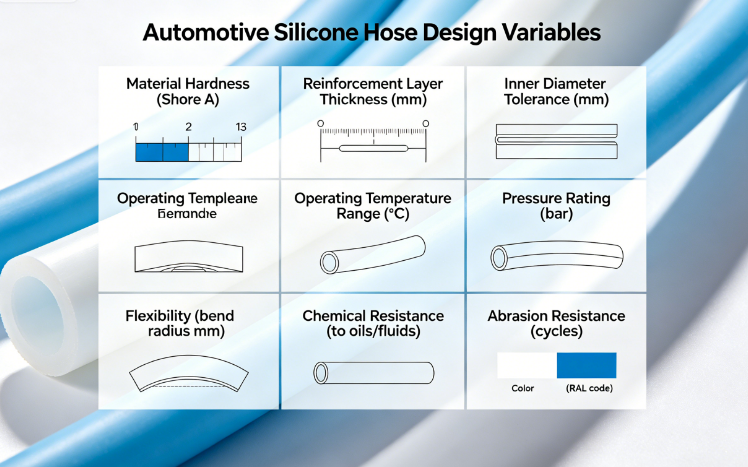
I decide silicone hose suitability by checking medium, working and peak temperature, pressure, pulse, reinforcement, bend radius, wall thickness, tolerance, clamp area, aging environment, and required standards.5 The material and the hose structure must match together.
I check the medium before the drawing
A drawing is useful, but it does not tell me everything. If the hose carries coolant, I need the coolant type. If it carries air, I need to know if the air contains oil mist. If it touches cleaning fluid, I need chemical information. The medium often decides the material choice before the shape does.
Temperature is next. I ask for normal working temperature and peak temperature. A short peak may be acceptable if the hose has margin. A constant high temperature is different. I also ask about the outside environment. Engine bays, battery systems, and outdoor equipment each create different aging conditions.
| Variable I ask for | Simple reason | Example detail I want |
|---|---|---|
| Medium | I need chemical fit. | Coolant type, dry air, oil mist, fuel, chemical. |
| Temperature | I need heat margin. | Normal temperature and short peak temperature. |
| Pressure | I need strength data. | Working pressure and burst requirement. |
| Pulse | I need fatigue data. | Pressure cycle and vibration condition. |
| Structure | I need build method. | Straight, elbow, braided, multi-layer, molded. |
| Tolerance | I need production target. | ID, OD, wall thickness, length, bend angle. |
| Standard | I need acceptance rule. | ROHS, REACH, FDA, SGS, or customer standard. |
I match the process to the need
In my production work, I see different processes solve different problems. Extrusion is useful for straight tubes, profiles, and long lengths. Molding is useful for shaped parts, rings, elbows, plugs, pads, and special geometry. Foaming is useful when cushioning, compression, and sealing are needed.6 Reinforcement is useful when the hose must resist pressure better than a simple silicone tube.
I also care about tolerance. Automotive buyers often focus on material first, but assembly fit can be just as important. A hose that is chemically correct can still leak if the clamp area is unstable. A seal that uses the right compound can still fail if compression is wrong. I treat material, structure, and process as one package. I do not separate them when I give a practical answer.
How Should Buyers Evaluate Silicone Hoses Before Ordering?
I often help buyers more when I ask questions than when I give quick prices. A fast quote can hide a slow failure.
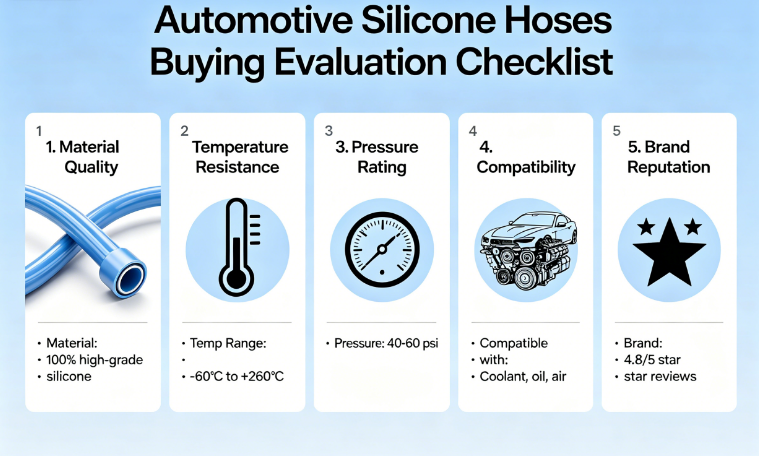
I suggest buyers define the application, medium, temperature, pressure, structure, drawings, tolerance, test standard, and expected life before ordering silicone hoses. I also suggest sample testing before mass production, especially for automotive and new-energy use.
I start with a clear application file
When a buyer sends me an inquiry, I prefer a simple application file. It does not need to be beautiful. It needs to be clear. I want to know where the hose sits, what it carries, what it touches, how it is fixed, and what failure would mean. If the hose is for a non-critical aftermarket part, the review may be simpler. If the hose is for a mass-production automotive system, the review must be deeper.
I also ask for drawings or samples. A photo is helpful, but it is not enough for production. I need inner diameter, outer diameter, wall thickness, length, bend angle, reinforcement details, hardness, color, and tolerance. If the buyer needs branding, special surface finish, or color matching, I need those details too.
| Step I use | What I ask the buyer | Why it matters |
|---|---|---|
| Application check | I ask where the hose is used. | I understand risk level. |
| Medium check | I ask what the hose contacts. | I judge material fit. |
| Heat check | I ask normal and peak temperature. | I judge aging risk. |
| Pressure check | I ask working and burst pressure. | I judge structure needs. |
| Drawing check | I ask for dimensions and tolerance. | I judge production feasibility. |
| Sample check | I ask for testing before bulk order. | I reduce mass-production risk. |
I see sampling as a safety tool
I do not view sampling as a delay. I view it as a safety tool. A sample can confirm the shape, size, hardness, color, assembly fit, and basic handling. It can also help the buyer run media tests, heat tests, pressure tests, and aging tests. For higher-risk automotive use, sampling is not enough by itself, but it is a needed first step.
I also suggest buyers keep batch control in mind. If a silicone hose is approved after testing, the later production must follow the same material grade, process route, structure, and inspection plan. A small change in fabric reinforcement, wall thickness, compound, or curing process can change performance. This is why I support clear specifications and batch inspection. I want the buyer to receive the same hose they tested, not a similar-looking product with different behavior.
Conclusion
I do not ask if silicone is better. I ask where it works, what it touches, how it is built, and how it is validated.
"(PDF) AIAG Production Part Approval process PP - Academia.edu", https://www.academia.edu/99043491/AIAG_Production_Part_Approval_process_PP. Automotive quality frameworks such as IATF 16949 and PPAP emphasize supplier approval, production validation, process control, and traceability, supporting the distinction between aftermarket use and OEM mass-production approval. Evidence role: expert_consensus; source type: institution. Supports: An automotive quality-management source should document requirements for supplier qualification, production part approval, validation, traceability, and process control.. Scope note: These frameworks describe industry quality processes generally and may not specify silicone hoses in particular. ↩
"Effects of Carbon Black on Mechanical Properties and Oil ... - PMC", https://pmc.ncbi.nlm.nih.gov/articles/PMC11013876/. Technical literature on elastomer compatibility and hose impulse testing links petroleum-fluid exposure to potential swelling or property loss in unsuitable elastomers and treats cyclic pressure loading as a distinct durability risk. Evidence role: mechanism; source type: paper. Supports: A technical source should explain that silicone rubber can swell or lose properties in certain petroleum fluids and that pressure impulse fatigue is a separate hose design concern.. Scope note: The evidence would support the risk mechanism; actual performance depends on the specific silicone compound, liner, reinforcement, and test conditions. ↩
"Research on the Material Compatibility of Elastomer Sealing O-Rings", https://pmc.ncbi.nlm.nih.gov/articles/PMC9414156/. Elastomer immersion testing evaluates fuel or oil compatibility through changes in volume, mass, hardness, and mechanical properties, providing a basis for the claim that incompatible silicone compounds may swell or lose performance after exposure. Evidence role: mechanism; source type: paper. Supports: A study or test-method reference should support that liquid exposure can be evaluated by changes in volume, mass, hardness, or tensile properties, and that incompatible fuels or oils can degrade elastomers.. Scope note: This supports the mechanism and evaluation method; it does not establish failure for every silicone formulation or every fuel and oil blend. ↩
"Crankcase ventilation system - Wikipedia", https://en.wikipedia.org/wiki/Crankcase_ventilation_system. Engine-system references describe crankcase ventilation as routing blow-by gases containing oil vapor or aerosol into the intake stream, supporting the need to consider oil mist in some intake or turbo-related hose locations. Evidence role: mechanism; source type: education. Supports: A source should explain that positive crankcase ventilation and turbocharger-related airflow can introduce oil vapor or aerosol into intake passages.. Scope note: The amount of oil mist varies by engine design, operating condition, and component condition. ↩
"[PDF] Introduction to Hydraulic Hose and Fittings", https://dlnr.hawaii.gov/mk/files/2017/01/Freitas-S-18-a.pdf. Hose engineering standards and guides identify fluid compatibility, temperature exposure, pressure rating, impulse durability, dimensions, bend radius, reinforcement, and aging tests as relevant criteria for hose selection and validation. Evidence role: expert_consensus; source type: institution. Supports: A hose standard or engineering guide should identify fluid compatibility, temperature, pressure, impulse, dimensions, bend radius, reinforcement, and aging tests as relevant to hose selection and validation.. Scope note: The source would support the checklist as an engineering approach, while exact requirements vary by hose type and customer standard. ↩
"High Consistency Silicone Rubber Foams - PMC - NIH", https://pmc.ncbi.nlm.nih.gov/articles/PMC11085819/. Polymer-processing references describe extrusion as suited to continuous profiles and tubing, molding as suited to shaped components, and foaming as suited to compressible sealing or cushioning materials. Evidence role: mechanism; source type: education. Supports: A polymer-processing source should explain how extrusion, molding, and foaming are used for different elastomer shapes and functions.. Scope note: This supports the process-function distinction generally; production feasibility also depends on compound, tooling, dimensions, and quality requirements. ↩
发表回复